
CLASS 6 SCIENCE · CHAPTER 1 · STUDY NOTES
The Wonderful World of Science
Learn to observe, ask, check and explain. Each topic has a picture and a small question to try.
01 / LOOK CLOSER
Science is closer than you think.
A leaf. A pan of water. The night sky. Ordinary things can lead to extraordinary questions.
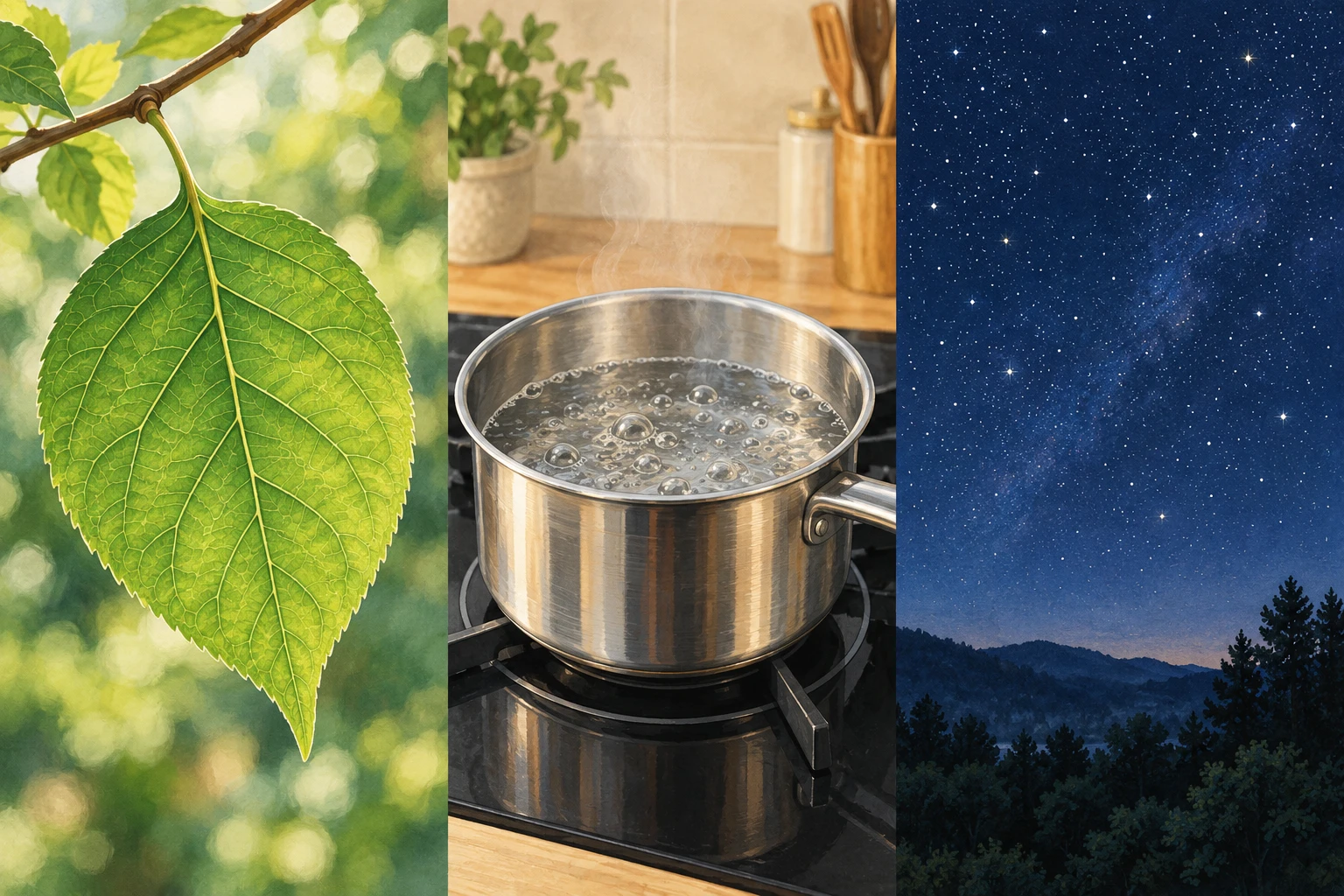
Notice, ask, then investigate
1. In the garden
I notice: Fine lines branch across the leaf.
I wonder: What do these lines do?
How could we begin finding out? Look closely at several leaves and compare the patterns. Then use a reliable explanation to learn what the veins do. Seeing a pattern alone does not tell us its job.
2. In the kitchen
I notice: Bubbles appear in the heated water.
I wonder: Why do bubbles appear as water heats up?
How could we begin finding out? With an adult, watch from a safe distance as water warms. Notice when bubbles appear and how they change. Do not touch the hot pan or water.
3. Under the stars
I notice: Small points of light fill the night sky.
I wonder: Why do stars shine?
How could we begin finding out? Observe the night sky to describe what you see. To understand why stars shine, we also need evidence and explanations from astronomers. Looking alone cannot reveal everything.
An observation tells us what happened. A question asks what we want to understand.
You do not need a laboratory to begin. You need curiosity—and a willingness to check your ideas.
Is asking “why?” enough?
Asking a question is a beginning. To find a reliable answer, we need evidence: things we can observe, measure or test. A guess may sound sensible and still be wrong. New evidence can help us change our explanation.
YOUR TURN
Now find a question of your own.
Look around you. Use a different object from the three above.
Question
Write one thing you can observe about that object. Then write a question you would like to investigate.

Sign in to see the answer
Write your own answer and compare it with ours. It’s free.
Sign inNew here? Sign up freeBased on NCERT Curiosity · Class 6 · Chapter 1, pages 1–2 and 5–6. Original Learnijoy examples and illustration.
02 / EXPLORE & UNDERSTAND
First notice, then ask
Your pen moves across the paper, but it leaves no ink mark. Start with what you can actually notice. The reason comes later.
One problem. Three different kinds of sentence.
OBSERVATION
The pen leaves no ink mark.

QUESTION
Why is the pen not writing?

POSSIBLE EXPLANATION
Perhaps the refill is empty.
1. Say what happened
“There is no ink mark” describes what you noticed. It does not tell you why.
2. Turn it into a question
Ask “Why is the pen not writing?” A useful question tells us what we want to find out.
3. Keep the guess separate
“The refill may be empty” is one possible answer. You still need to check it. A guess is not the same as an observation.
A little deeper
An observation can use a measuring tool too. For example, “the thermometer reads 30°C” records a measurement. “It must be summer” is a separate explanation that needs more information.
Your turn
Question
Is “the ink must be empty” an observation or a possible explanation?
Sign in to see the answer
Write your own answer and compare it with ours. It’s free.
Sign inNew here? Sign up freeNCERT · Curiosity · Chapter 1, PDF pages 1, 5, 6 · Original Learnijoy explanations and examples.
03 / EXPLORE & UNDERSTAND
A guess needs a check
Suppose you think the pen has stopped because its ink is finished. Looking inside the refill helps you check this idea.
Check the same guess against two possible results
IF THE REFILL IS EMPTY
No ink visible inside
This supports the idea that the ink has run out.
IF INK REMAINS
Blue area = ink remaining
“No ink left” does not fit. Look for another reason.
1. Look for evidence
For a pen that opens safely, inspect the refill. Record what you actually see. Do not write the result you hoped to find.
2. Let the result change your idea
If ink remains, the ink might have dried near the tip, or there may be another problem. That is a new guess—not a proven answer.
A little deeper
Finding some support is useful, but do not claim more than you checked. Seeing ink in a refill rules out “completely empty”; it does not tell you the exact cause of the problem.
Your turn
Question
You find ink in the refill. What should happen to your first guess?
Sign in to see the answer
Write your own answer and compare it with ours. It’s free.
Sign inNew here? Sign up freeNCERT · Curiosity · Chapter 1, PDF pages 5, 6 · Original Learnijoy explanations and examples.
04 / EXPLORE & UNDERSTAND
Follow the evidence, step by step
An investigation is a way to work towards an answer. Let us follow the pen problem from the first observation to a better question.
A worked investigation: the pen will not write
1 · OBSERVE
No ink mark appears.
2 · ASK
Why has it stopped writing?
3 · GUESS
Perhaps the ink is finished.
4 · CHECK
Inspect the refill. Suppose ink remains.

5 · THINK AGAIN
The first guess does not fit. What else could be wrong?
1. Check an idea in a useful way
The check should help answer your question. Looking at the pen’s colour would not tell you whether the refill is empty.
2. Explain what the result means
Analysing means thinking carefully about the result. Here, ink remaining means we need a different explanation.
A little deeper
Keep a short record: my question, my guess, what I checked, what I noticed and what I now think. A record helps someone else understand your reasoning and repeat a suitable check.
Your turn
Question
Why might you test an idea again?
Sign in to see the answer
Write your own answer and compare it with ours. It’s free.
Sign inNew here? Sign up freeNCERT · Curiosity · Chapter 1, PDF pages 5, 6, 7 · Original Learnijoy explanations and examples.
05 / EXPLORE & UNDERSTAND
Science helps with everyday problems
You do not need a special job title to think scientifically. The important thing is to ask a question and look for evidence before deciding.
Match the problem to a useful question
BICYCLE REPAIR
A tyre is flat. Where is the air escaping?
COOKING
Dal has spilled from a cooker. Was there too much water?
ELECTRICAL REPAIR
A light is not working. Is the fault in the bulb or somewhere else?
1. Avoid guessing the repair
A flat tyre tells us there is a problem. It does not tell us where the leak is. A repair person checks before choosing a repair.
2. Ask someone who can check safely
A learner can notice and ask. Hot cookers and electrical faults need a responsible adult or a trained person. Do not test them yourself.
A little deeper
Observation and experiments are both useful. Sometimes careful watching is enough to gather evidence; sometimes a safe test is needed. The question decides what kind of check will help.
Your turn
Question
Why should a repair person inspect a tyre before replacing it?
Sign in to see the answer
Write your own answer and compare it with ours. It’s free.
Sign inNew here? Sign up freeNCERT · Curiosity · Chapter 1, PDF pages 6, 7 · Original Learnijoy explanations and examples.
06 / EXPLORE & UNDERSTAND
One world, connected ideas
The topics in this book are not separate islands. One everyday thing—water—can lead us into several different parts of science.
Water connects three questions
 WATEROne substance, several connections
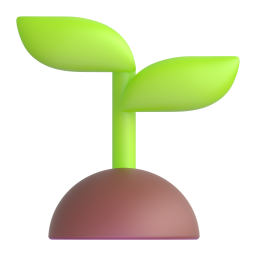
is needed by living things
Life
Plants and animals need water.
can freeze when cooled
Ice
Liquid water can become solid ice.
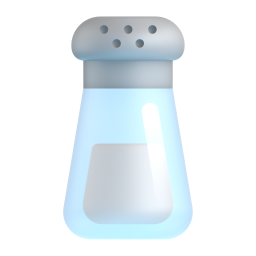
can mix with materials
Mixtures
Salt can dissolve in water.
1. Explore life and food
Earth is the only planet currently known to support life. We will learn about different living things, the food we eat and the natural resources we need to protect.
2. Explore materials and change
Think about a metal key, a plastic ruler or a rubber eraser. What are they made of? How do we measure things, use magnets, study movement and separate mixtures?
3. Look beyond Earth too
The Sun, Moon and stars raise more questions. This chapter opens the journey; later chapters explain these ideas in detail.
A little deeper
Knowing a connection helps you use ideas together. For example, a question about rain can involve water, temperature and the surroundings. You do not have to learn the full answer in this opening chapter.
Your turn
Question
How could studying water connect with studying living things?
Sign in to see the answer
Write your own answer and compare it with ours. It’s free.
Sign inNew here? Sign up freeNCERT · Curiosity · Chapter 1, PDF pages 3, 4, 5 · Original Learnijoy explanations and examples.
07 / EXPLORE & UNDERSTAND
Stay curious. Learn together.
Not knowing an answer is a good place to begin. Scientists ask questions, share what they find and improve explanations when new evidence appears.
Two observations can help us ask a better question
LEARNER A NOTICES
“This leaf has many branching lines.”
LEARNER B NOTICES
“The lines on my leaf look more parallel.”
A SHARED QUESTION
“Do different kinds of leaves have different patterns?”
1. Compare, do not dismiss
Different observations do not automatically mean someone is wrong. The learners may be looking at different kinds of leaves. Compare what each person examined.
2. Change your mind when evidence changes
The book compares science with an unfinished jigsaw puzzle. New discoveries add pieces; sometimes an old piece needs a new place. An explanation can improve.
3. Keep your next question
You will not find every answer in Class 6. Write down a question, think of a safe way to investigate it and ask for help when needed. Learning continues beyond this book.
A little deeper
Working together means sharing evidence as well as ideas. A useful response is “show me what you noticed”, followed by a careful comparison—not simply choosing the most confident speaker.
Your turn
Question
Your friend gets a different observation. What could you do together?
Sign in to see the answer
Write your own answer and compare it with ours. It’s free.
Sign inNew here? Sign up freeCHAPTER RECAP
Three ideas to take with you
- Separate what you noticed from what you think caused it.
- Check a guess with evidence. Change it when the evidence asks you to.
- Keep asking questions and learn with others.
Try your thinking in three new situations
Question
A puddle is smaller in the afternoon. A learner says, “Someone must have swept the water away.” What is the observation, and what is the guess?
Sign in to see the answer
Write your own answer and compare it with ours. It’s free.
Sign inNew here? Sign up freeQuestion
A torch does not light. You guess its batteries are empty. An adult puts those batteries in another working torch, and it lights. What should you change in your thinking?
Sign in to see the answer
Write your own answer and compare it with ours. It’s free.
Sign inNew here? Sign up freeQuestion
Two learners count different numbers of ants on a plant. Does that prove one learner is careless? Suggest a fair next step.
Sign in to see the answer
Write your own answer and compare it with ours. It’s free.
Sign inNew here? Sign up freeNCERT · Curiosity · Chapter 1, PDF pages 7, 8 · Original Learnijoy explanations and examples.