
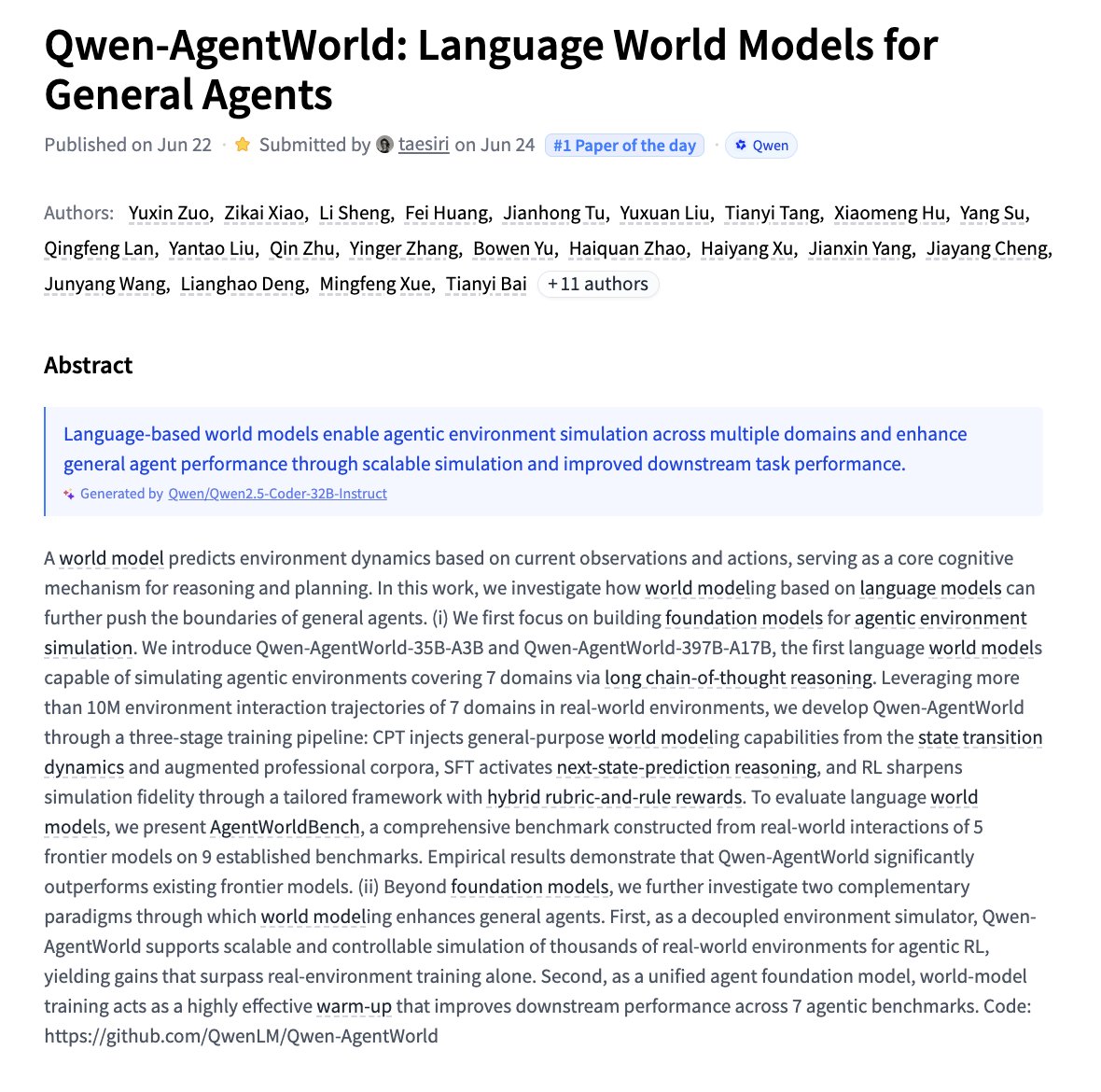
Qwen-AgentWorld Introduces Language World Models for General Agents.
Key takeaways
- Qwen-AgentWorld introduces Language World Models for general AI agents.
- The goal is to create more versatile and capable AI systems.
- This research could lead to significant advancements in AI autonomy.
- Professionals should monitor developments in general agent architectures.
Who benefits
Summary
A new research paper introduces "Qwen-AgentWorld," a framework utilizing Language World Models designed to create more general and capable AI agents. The post points to the paper for details on this development.
Why it matters
This research could significantly advance the development of more autonomous and versatile AI agents, impacting fields from automation to complex decision-making systems. Professionals can anticipate future AI tools with enhanced understanding and adaptability.
How to implement this in your domain
- 1Review the research paper: Understand the technical details and potential applications of Language World Models for agent development.
- 2Experiment with agent frameworks: Explore how similar LWM concepts could be integrated into existing or new AI agent architectures.
- 3Consider new agent use cases: Identify business problems that could be solved by more general and capable AI agents.
- 4Collaborate with AI researchers: Engage with academic or industry experts working on advanced agent technologies.
Original post by @_akhaliq
"Qwen-AgentWorld Language World Models for General Agents paper:"
View on XOriginally posted by @_akhaliq on X · view source
Want to go deeper?
Turn these trends into skills with Learnijoy's hands-on AI & tech courses.
Explore coursesMore in AI Research
Scientists Create Female Clones from Male Mouse Embryos Using CRISPR
Scientists in Japan have successfully transformed male mouse embryos into females by removing the Y chromosome with a CRISPR-based approach, creating female clones from male genetic material. This marks the first time such a feat has been achieved.
LFM2.5-VL-3B Enhances Edge Vision Capabilities
A new model, LFM2.5-VL-3B, is introduced to provide better and faster vision capabilities specifically optimized for edge devices. This advancement aims to improve performance and efficiency for AI applications running locally.
Tiered KV Cache Boosts Large LLM Inference on SageMaker HyperPod
Running large language model inference at scale often involves a trade-off between large GPU instances and slow time-to-first-token due to KV cache limitations. This post describes building a tiered KV cache on Amazon SageMaker HyperPod, extending the cache into a shared, distributed NVMe pool with Curvine, allowing replicas to reuse cache at near-local-disk speeds on cost-efficient instances.