
Anthropic's Claude Sonnet 5 Boosts Coding and Agent Capabilities
Key takeaways
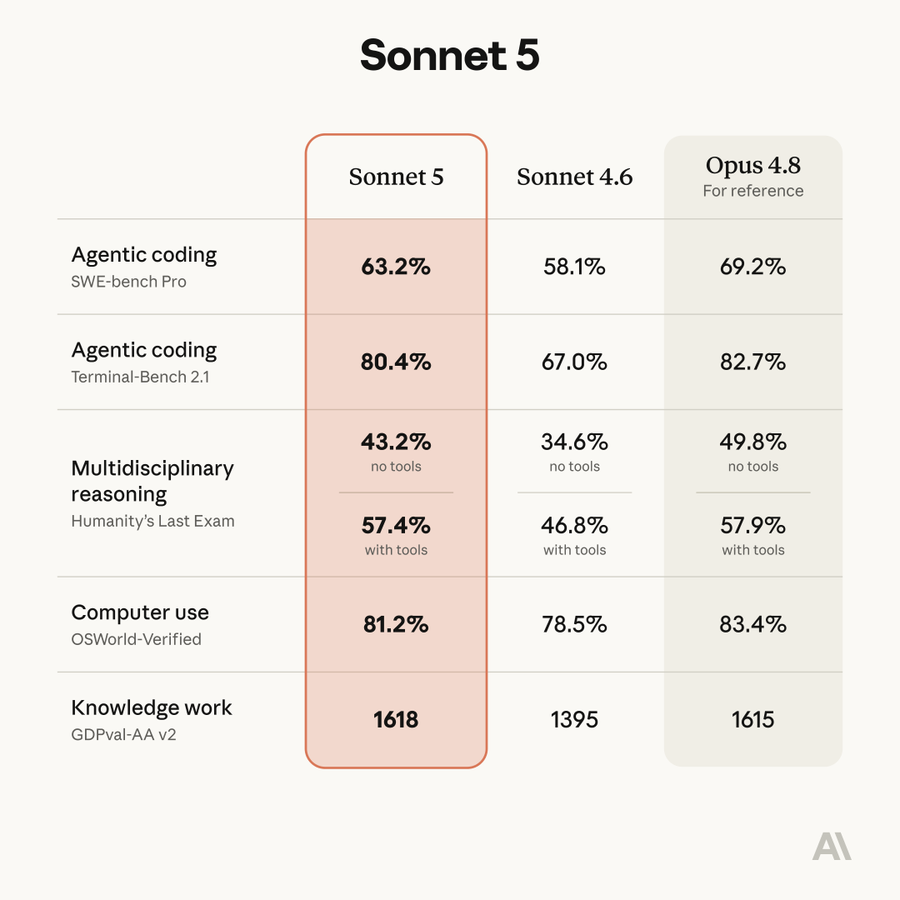
- Claude Sonnet 5 shows major improvements in coding and agentic capabilities.
- It outperforms Sonnet 4.6 significantly.
- Sonnet 5's knowledge work scores surpass Opus 4.8.
- This release offers enhanced general intelligence for professional tasks.
Who benefits
Summary
Anthropic has released Claude Sonnet 5, demonstrating significant improvements in coding and agentic capabilities compared to Sonnet 4.6, and achieving knowledge work scores that surpass Opus 4.8.
Why it matters
Professionals relying on AI for coding, autonomous agents, or complex knowledge work can expect a considerable boost in efficiency and accuracy with Claude Sonnet 5, potentially outperforming even higher-tier models in certain domains.
How to implement this in your domain
- 1Evaluate Sonnet 5 for code generation, debugging, and refactoring tasks.
- 2Integrate Sonnet 5 into agent-based systems to enhance decision-making and task execution.
- 3Compare its knowledge work performance against existing models for information retrieval and synthesis.
- 4Train teams on prompt engineering techniques specific to Sonnet 5 to maximize its new capabilities.
Original post by @TheRundownAI
"NEW: Anthropic releases Claude Sonnet 5 Big jump in coding, agentic capabilities over 4.6, with knowledge work scores surpassing Opus 4.8."
View on XOriginally posted by @TheRundownAI on X · view source
Want to go deeper?
Turn these trends into skills with Learnijoy's hands-on AI & tech courses.
Explore coursesMore in AI News & Tools
B2B Marketers Seek Pardot Alternatives Amidst Rapid Industry Change
The marketing industry has undergone significant transformation, leading many B2B marketers to seek alternatives to traditional platforms like Pardot due to perceived lack of development. This shift highlights the need for marketing automation tools to adapt to evolving market demands.
Instagram Redesigns Wordmark; Zuckerberg Details AI Future
Instagram has unveiled a new wordmark, sparking debate about its design, while Mark Zuckerberg released a comprehensive memo outlining Meta's vision for AI development.
Google Gemini Allows Disabling Visible AI Watermarks
Google now permits users to turn off visible watermarks on content generated by Gemini and Flow, though invisible SynthID watermarks and C2PA metadata will remain embedded for provenance.