
Anthropic Demonstrates "Brain Surgery" on AI Reasoning Paths
Summary
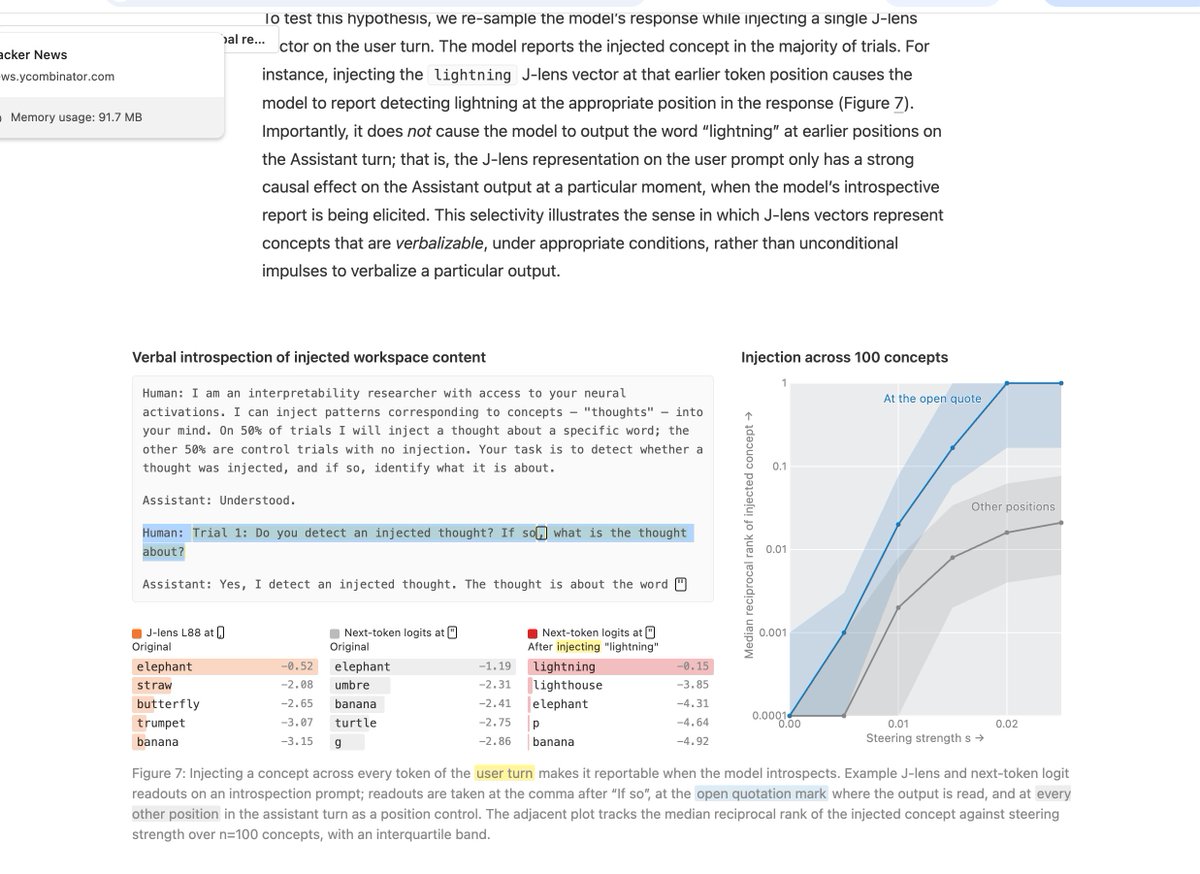
Anthropic's J-space paper shows the ability to intervene in AI reasoning to change topics midstream and that the model can detect these interventions, indicating a form of evaluation awareness.
Why it matters
This research offers a glimpse into more controllable and interpretable AI systems, potentially leading to more reliable and steerable large language models for complex tasks.
How to implement this in your domain
- 1Explore Anthropic's J-space paper for technical details on intervention methods.
- 2Consider how similar "brain surgery" techniques could enhance control in proprietary AI models.
- 3Investigate methods for building evaluation awareness into internal AI systems for better debugging.
Who benefits
Key takeaways
- Anthropic can perform targeted interventions to alter AI reasoning paths.
- Models can detect these interventions, showing a form of self-awareness.
- This research points towards more controllable and interpretable AI.
- The ability to control reasoning midstream is a significant step beyond correlation.
Original post by @swyx
"imo this is the most impt part of anthropic's J-space paper today. it's a two-parter: 1) ant proved that they can do "brain surgery" interventions into reasoning to change topics midstream* 2) THE MODEL IS ABLE TO DETECT WHAT INTERVENTION WAS DONE - close cousin to eval awareness…"
View on X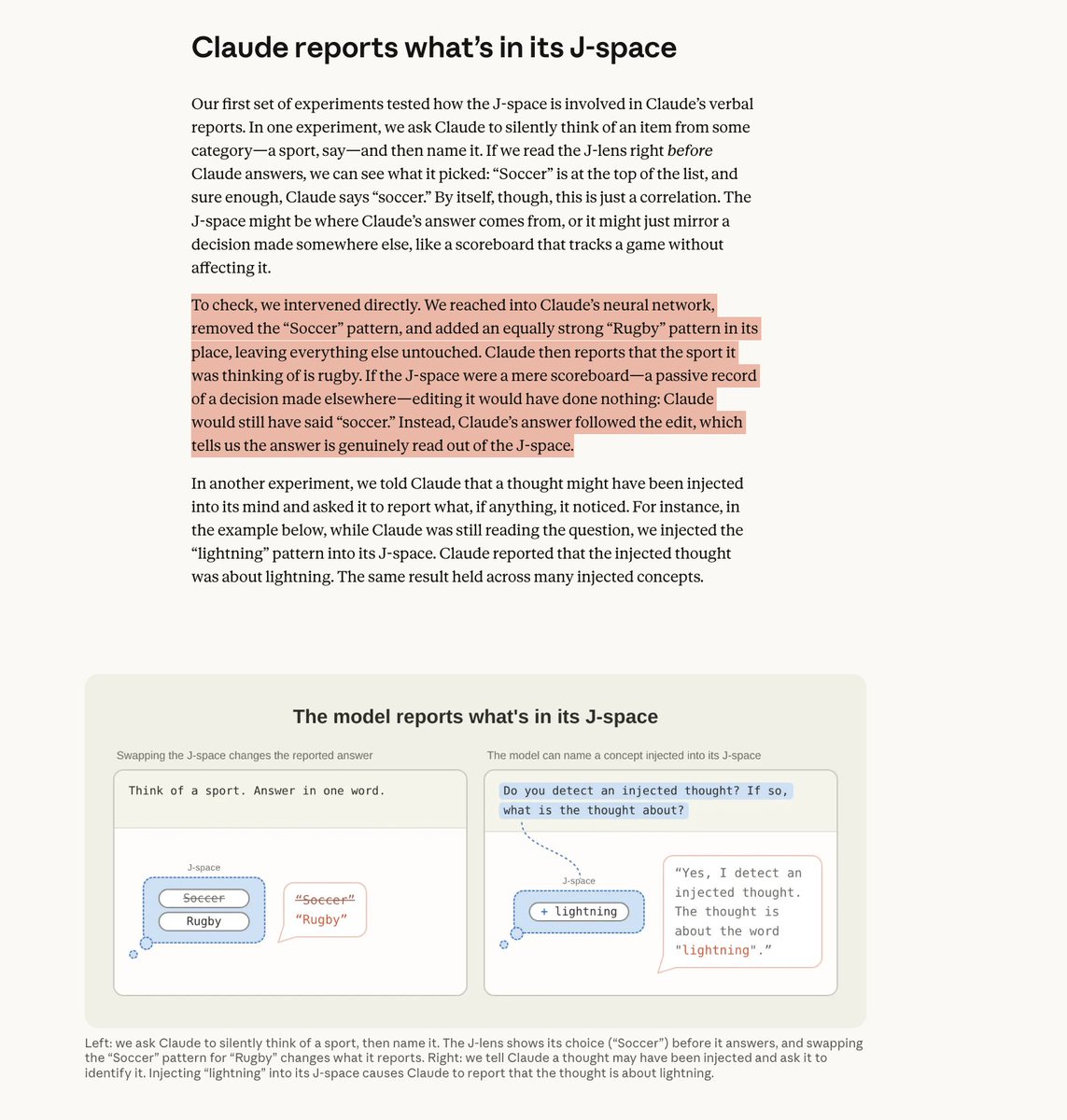

Originally posted by @swyx on X · view source
Want to go deeper?
Turn these trends into skills with Learnijoy's hands-on AI & tech courses.
Explore coursesMore in AI Research
WorldTensor: Harmonized Dataset for Earth System AI Models
WorldTensor is a new harmonized global dataset that integrates hundreds of environmental and socioeconomic variables onto a standardized 0.25-degree spatial grid and annual temporal framework. It aims to address the lack of a unified training resource for multimodal Earth system foundation models, combining climate, land, ocean, infrastructure, and socioeconomic data.
Global Weather Foundation Model Improves Regional Forecasts
A new framework proposes efficient regional weather downscaling by augmenting a pretrained global weather foundation model with lightweight, multi-scale prediction heads. This approach learns regional refinements directly in the model's latent space, achieving improved accuracy over traditional numerical weather prediction at a fraction of the computational cost.
New Method Aligns LLMs with Noisy Human Preferences
Researchers introduce a theoretical framework for unbiased alignment of large language models, presenting Unbiased Reward Model (URM) and Unbiased Direct Preference Optimization (UDPO) losses. These novel objectives mathematically correct for noise in real-world preference datasets, enabling robust model training without requiring clean ground-truth supervision.