
New Research on Vision Pretraining for Spatial Perception
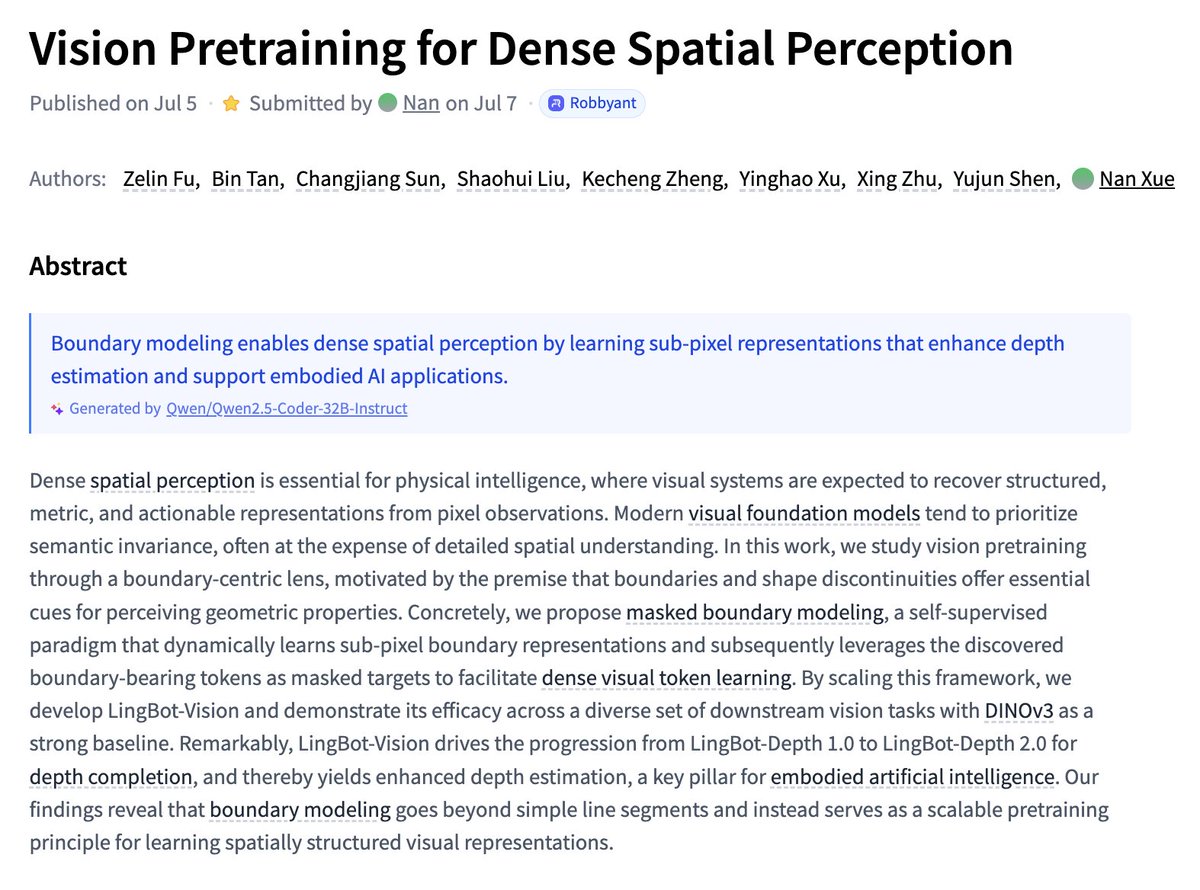
Key takeaways
- The paper introduces new vision pretraining methods for spatial perception.
- Improved spatial understanding is vital for advanced AI applications.
- This research could enhance capabilities in robotics and autonomous systems.
- Pretraining is a key area for developing robust visual AI.
Who benefits
Summary
This research paper explores advancements in vision pretraining techniques specifically designed to enhance dense spatial perception in AI systems. The study focuses on improving how models understand and interpret 3D space from visual input.
Why it matters
Advancements in dense spatial perception are crucial for developing more capable autonomous systems, robotics, and augmented reality applications, directly impacting product development and operational efficiency in various industries.
How to implement this in your domain
- 1Review the paper's methodology for potential integration into current computer vision projects.
- 2Explore open-source implementations or pre-trained models released alongside the research.
- 3Evaluate the applicability of these pretraining techniques for specific spatial understanding tasks.
- 4Consider collaborating with research institutions working on similar perception challenges.
- 5Benchmark existing spatial perception models against the techniques proposed in the paper.
Primary sources
Originally posted by @_akhaliq on X · view source
Want to go deeper?
Turn these trends into skills with Learnijoy's hands-on AI & tech courses.
Explore coursesMore in AI Research
AI Tool Prioritizes Biomarkers from Wearable Sensor Data
A new AI tool leverages generative AI to prioritize candidate biomarkers identified from wearable sensor data, streamlining the discovery process in health research.
Reduce RAG Costs with Query-Aware Compression on Bedrock
A new pattern on Amazon Bedrock uses query-aware context compression to reduce Retrieval Augmented Generation (RAG) costs by filtering retrieved chunks with a smaller model before the primary model processes them, maintaining answer quality.
AI Boosted Homework, But Exam Scores Dropped: Study
A study found that while AI tools helped students achieve higher homework scores, their subsequent exam performance declined, suggesting a potential over-reliance or lack of true understanding.