
OPSD-V: New Method for Efficient Autoregressive Video Generation
Key takeaways
- OPSD-V is a novel self-distillation technique for video generators.
- It focuses on improving post-training for autoregressive models.
- The method aims to enhance efficiency and quality in few-step video generation.
- This research could lead to more advanced and practical video creation AI.
Who benefits
Summary
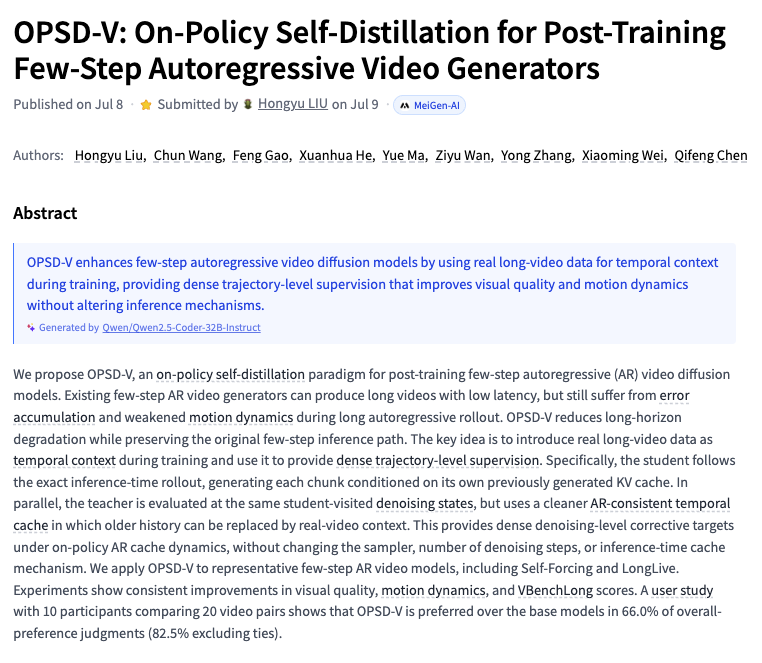
A new research paper introduces OPSD-V, an On-Policy Self-Distillation technique designed to improve post-training for few-step autoregressive video generators, enhancing their efficiency and performance.
Why it matters
This research offers a technical advancement for AI video generation, potentially leading to more efficient and higher-quality video creation tools, which is relevant for anyone involved in content production or AI model development.
How to implement this in your domain
- 1Review the OPSD-V paper to understand the technical details and implementation strategy.
- 2Experiment with integrating self-distillation techniques into existing video generation model training pipelines.
- 3Evaluate the performance improvements of OPSD-V on specific video generation tasks compared to current methods.
- 4Consider contributing to open-source implementations or developing proprietary tools based on this research.
Original post by @_akhaliq
"OPSD-V On-Policy Self-Distillation for Post-Training Few-Step Autoregressive Video Generators paper:"
View on XPrimary sources
Originally posted by @_akhaliq on X · view source
Want to go deeper?
Turn these trends into skills with Learnijoy's hands-on AI & tech courses.
Explore coursesMore in AI Research
AI Enhances Metadata Correction and Harmonization
This post explores how AI can automate metadata correction and harmonization, a process typically done manually to standardize data for interoperability. It discusses human-in-the-loop and autonomous agent approaches, along with governance for production.
Kids Outperform AI in Language Learning Efficiency
Children learn language with significantly less data than large language models, a phenomenon scientists are still working to understand. This efficiency gap highlights fundamental differences between human and artificial intelligence.
Children Outperform AI in Language Acquisition, Mystery Remains
Human children still learn language with perfect fluency more efficiently than advanced AI models, a phenomenon scientists do not yet fully understand. This highlights a significant gap in current artificial intelligence capabilities compared to biological learning.