
Apple Sues OpenAI Over Alleged Trade Secret Theft
Key takeaways
- Apple is suing OpenAI for alleged trade secret theft by former employees.
- The lawsuit centers on the development of competing AI hardware.
- This case underscores the high stakes in AI intellectual property.
- It could set precedents for employee movement between tech giants.
Who benefits
Summary
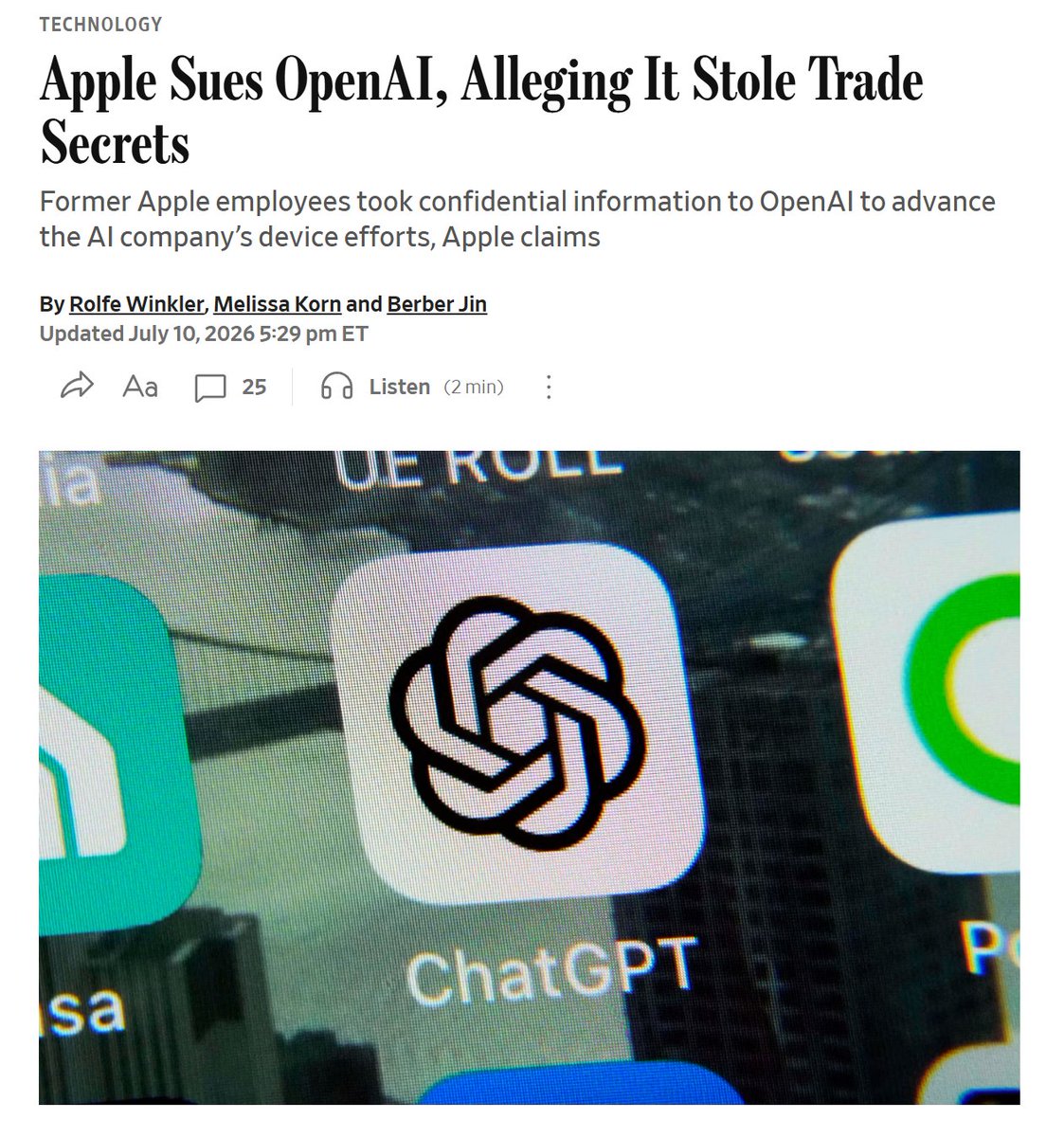
Apple has filed a lawsuit against OpenAI, accusing former Apple employees of stealing trade secrets. The lawsuit claims these secrets were used to develop competing AI hardware at OpenAI.
Why it matters
This lawsuit highlights critical issues around intellectual property, employee non-compete clauses, and the intense competition in the AI hardware space, impacting strategic decisions for companies and talent.
How to implement this in your domain
- 1Review internal intellectual property protection policies and agreements.
- 2Educate employees on trade secret confidentiality and non-disclosure obligations.
- 3Monitor competitive AI hardware developments for potential IP infringements.
- 4Consult legal counsel on implications for hiring from competitors or employee departures.
Original post by @minchoi
"Holy smokes... Apple just sued OpenAI. It alleges former Apple employees stole trade secrets to help build competing AI hardware. Source: @ekemini58110 I mean... @godsbstrdchild 🤔"
View on XPrimary sources
Originally posted by @minchoi on X · view source
Want to go deeper?
Turn these trends into skills with Learnijoy's hands-on AI & tech courses.
Explore coursesMore in AI News & Tools
SageMaker HyperPod Adds Managed Ray Support on EKS
Amazon SageMaker HyperPod now provides managed Ray support on Amazon EKS, enabling users to create and monitor Ray clusters directly. This integration facilitates distributed training and accelerated inference within SageMaker Studio, leveraging open-source KubeRay and standard Ray APIs.
Build AI-Powered Knowledge Management with AWS Bedrock
This guide demonstrates how to construct a customizable, smart-caching knowledge management system on AWS, designed to capture and deliver institutional knowledge via a voice-first AI avatar. The solution leverages Amazon Bedrock Knowledge Bases for retrieval-augmented generation and can be deployed rapidly using AWS CloudFormation.
LLM-Anthropic Library Updates to Version 0.27
The llm-anthropic library has been updated to version 0.27, indicating a new release for the tool that likely includes improvements or fixes.