
OpenAI Safety Head Departs Amidst Team Reorganization

Key takeaways
- OpenAI is restructuring its safety and research teams.
- A key safety leader is departing, and a new VP is taking over the combined group.
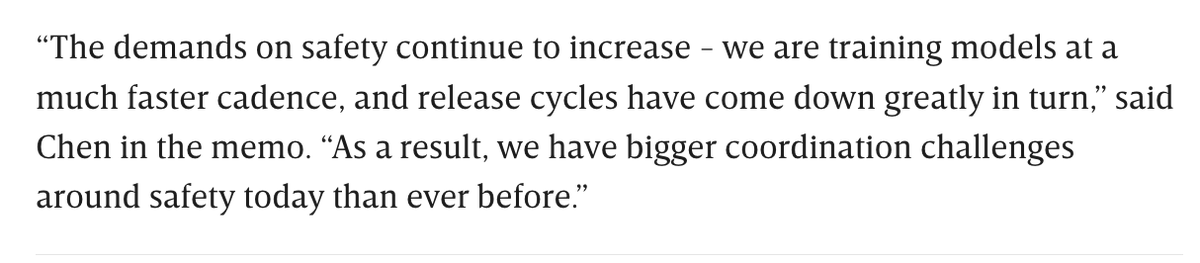
- The reorganization aims to address increased safety challenges due to faster model training.
- This reflects a strategic shift in how OpenAI approaches AI development and safety.
Who benefits
Summary
OpenAI's head of safety systems, Johannes Heidecke, is leaving the company as OpenAI reorganizes its safety and research teams under Mia Glaese to address growing coordination challenges with faster model training.
Why it matters
This signals OpenAI's evolving strategy for managing AI safety alongside rapid development, impacting future AI product reliability and ethical considerations for professionals using or building with their models.
How to implement this in your domain
- 1Monitor OpenAI's future announcements regarding safety protocols and model releases.
- 2Evaluate the safety implications of integrating new OpenAI models into existing products.
- 3Engage with industry discussions on AI safety and governance best practices.
Original post by @ZeffMax
"Scoop: OpenAI's head of safety systems, Johannes Heidecke, is leaving the company. Plus... -OpenAI is reorganizing its safety and research teams to bring them closer together -Mia Glaese will lead this combined group as VP of research and safety More here: In a memo to staff, Che…"
View on XPrimary sources
Originally posted by @ZeffMax on X · view source
Want to go deeper?
Turn these trends into skills with Learnijoy's hands-on AI & tech courses.
Explore coursesMore in AI News & Tools
TessIndex Introduces Verified Identity System for the Autonomous Agent Economy
TessIndex proposes a capability-verified identity system for autonomous software agents, addressing the lack of persistent identity, verifiable capability claims, and economic valuation in the emerging agent economy. It uses a dual-plane architecture with blockchain for commitments and centralized servers for dynamic metadata.
HIRA Boosts Document Classification in Regulated Industries.
HIRA is a training-free, on-premises human-in-the-loop retrieval-augmented cascade designed for document classification in regulated industries, combining multiple retrieval methods and an LLM verifier to achieve high accuracy with minimal human review and no model retraining.
IBM LinuxONE Accelerates Secure Enterprise RAG with Spyre
IBM has developed a cloud-native RAG architecture for its LinuxONE system, utilizing the Spyre accelerator card for generative AI inference. This solution keeps sensitive data within the hardware perimeter, offering high throughput and enhanced security for enterprise AI workloads.