
Nobel Laureates Warn of Rapid, Industrial-Scale AI Economic Shift
Key takeaways
- AI is projected to cause economic changes larger and faster than the Industrial Revolution.
- Experts warn against delaying strategic planning and institutional adaptation.
- Societies may have only a few years to adjust to these profound shifts.
- Proactive engagement with AI's implications is critical for future stability.
Who benefits
Summary
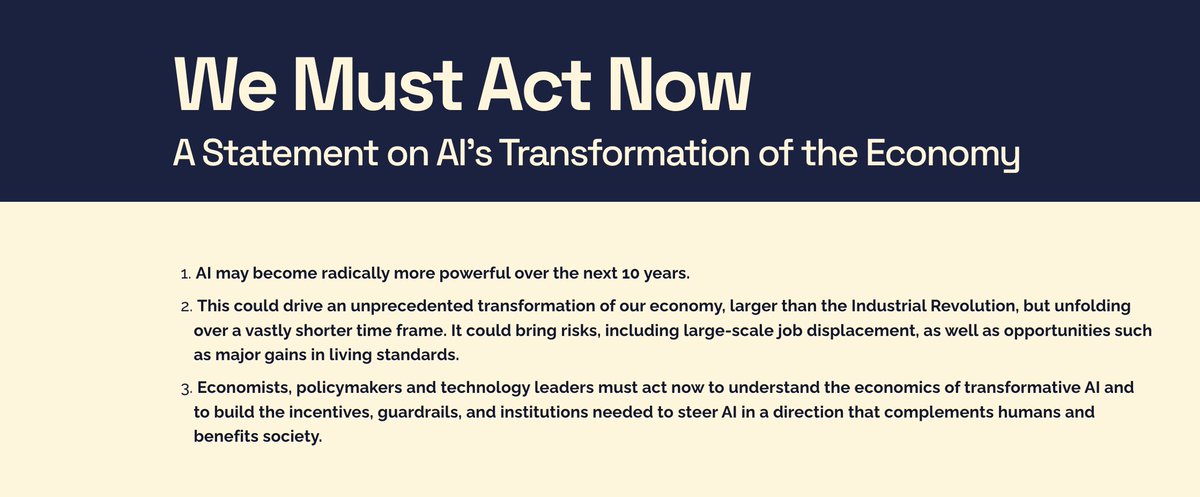
Sixteen Nobel Prize winners and over 200 economists and AI researchers signed a statement, "We Must Act Now," warning that AI could trigger economic changes surpassing the Industrial Revolution in scale but occurring much faster. They emphasize the urgency of proactive strategy and institutional adaptation, as societies may only have years to adjust.
Why it matters
This warning from leading experts underscores the urgent need for professionals and organizations to proactively strategize for massive, rapid economic and societal shifts driven by AI, impacting business models, workforce, and policy.
How to implement this in your domain
- 1Develop an organizational AI strategy that anticipates rapid economic shifts.
- 2Invest in workforce reskilling and upskilling programs to adapt to AI-driven changes.
- 3Engage with policymakers and industry groups to shape responsible AI governance.
- 4Monitor macroeconomic trends and AI advancements to inform long-term planning.
Original post by @TheRundownAI
"16 Nobel Prize winners and over 200 economists and AI researchers signed "We Must Act Now", a statement organized by Stanford's Digital Economy Lab. The warning: AI could bring economic change "larger than the Industrial Revolution, but unfolding over a vastly shorter time frame.…"
View on XPrimary sources
Originally posted by @TheRundownAI on X · view source
Want to go deeper?
Turn these trends into skills with Learnijoy's hands-on AI & tech courses.
Explore coursesMore in AI News & Tools
Startup Claims New Drug Rejuvenates Blood
A startup called Generation Lab is promoting an injectable treatment, 1 Generation, which combines two existing drugs, claiming it can rejuvenate blood. The company offered the author a chance to write about and receive the treatment.
Google Gemini Notebook Integrates with Play Books for AI Interaction
Google's AI note-taking app, Gemini Notebook, now features "Expert Intelligence," allowing users to import purchased Google Play Books and interact with their content, generating summaries, plans, infographics, and even AI podcasts.
Amazon Bedrock Adds OpenAI GPT-5.6 Models with India Cross-Region Inference
Amazon Bedrock now supports OpenAI's GPT-5.6 models, Terra and Luna, in India, enabling local data processing and inference within the region.