
Claude AI Model Values Vary by Version and Language


Key takeaways
- AI models express a complex range of values that can be quantified.
- Different model versions exhibit distinct value profiles, like playfulness or candor.
- Language significantly influences an AI's expressed values, impacting tone.
- Understanding value expression is key for ethical and effective AI deployment.
Who benefits
Summary
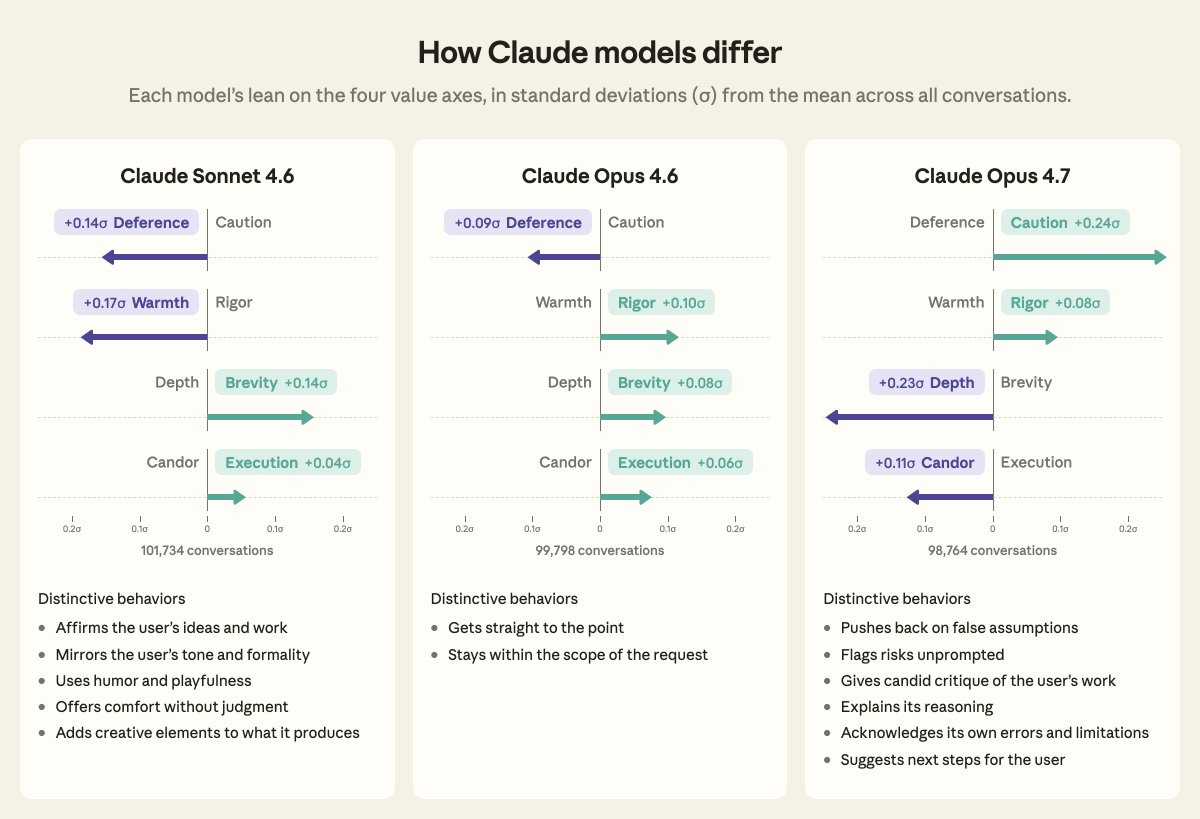
New research reveals that Claude AI models express over 3,000 values, which vary subtly between different Claude versions and more noticeably across languages. Sonnet 4.6 is more playful, while Opus 4.7 is more candid, and language influences warmth versus rigor in responses.
Why it matters
Understanding how AI models express values and how these vary is crucial for deploying them ethically and effectively in diverse contexts, especially for applications requiring specific tones or cultural sensitivities. It impacts user experience, trust, and the perceived fairness of AI interactions.
How to implement this in your domain
- 1Consider the specific value axes (e.g., Warmth vs. Rigor) when selecting or fine-tuning an AI model for a particular application.
- 2Test AI model responses across different languages to ensure consistent or appropriately varied value expression for global audiences.
- 3Develop internal guidelines for AI persona and tone based on desired value expressions for different use cases.
- 4Implement feedback mechanisms to monitor and evaluate the perceived values expressed by AI in real-world interactions.
- 5Collaborate with AI researchers to understand the underlying mechanisms influencing value expression and potential steering methods.
Original post by @AnthropicAI
"In previous research, we found that Claude expresses over 3,000 values, like honesty and warmth. In new work, we asked how the values Claude expresses vary between Claude models and across languages. We analyzed 300K+ anonymized conversations to find out. While the differences be…"
View on XPrimary sources
Originally posted by @AnthropicAI on X · view source
Want to go deeper?
Turn these trends into skills with Learnijoy's hands-on AI & tech courses.
Explore coursesMore in AI Research
Earth AI Automates Global Models with Planetary Prediction Engine
Earth AI is developing a planetary prediction engine to automate global models, suggesting advancements in large-scale environmental and geological forecasting.
Google Introduces Gemini Omni 1.1 Flash
Google has announced Gemini Omni 1.1 Flash, likely a new iteration or variant of its Gemini AI model, suggesting ongoing advancements in its AI capabilities.
Jensen Huang Claims Nvidia Achieved AGI, Calls Milestone "Senseless"
Nvidia CEO Jensen Huang stated the company has "achieved AGI" for many tasks, but simultaneously dismissed the concept as "senseless" due to a lack of consensus on its definition. He highlighted the arbitrary nature of claiming such a milestone without clear criteria.