
New Research: Weak-to-Strong Generalization in AI.
Key takeaways
- New research explores improving weaker AI models using stronger ones.
- Direct On-Policy Distillation is a novel knowledge transfer method.
- This could lead to more efficient and scalable AI deployments.
- The technique aims to enhance generalization capabilities of AI.
Who benefits
Summary
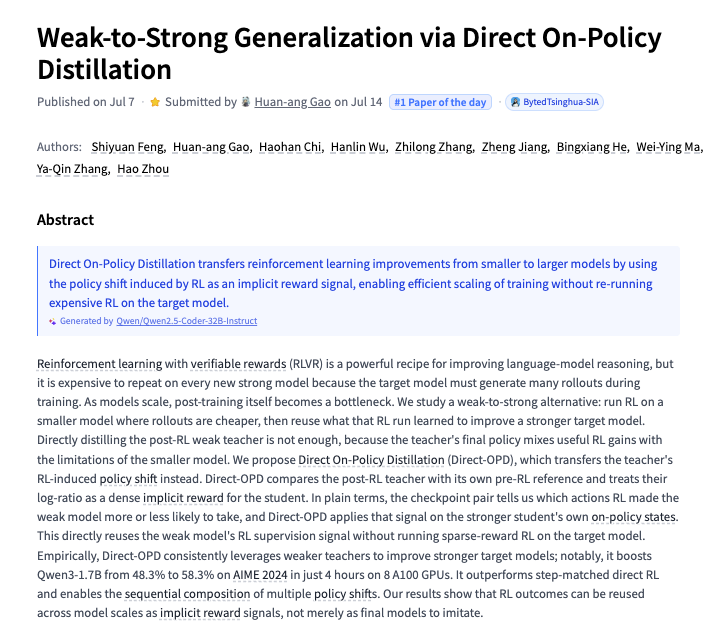
A new research paper introduces a method called "Weak-to-Strong Generalization via Direct On-Policy Distillation," which explores how to improve the capabilities of weaker AI models by leveraging stronger ones. The paper details a novel approach to knowledge transfer and model generalization.
Why it matters
This research offers a pathway to improve the efficiency and performance of AI models, potentially allowing for the deployment of more capable models on resource-constrained systems or accelerating the development of specialized AI applications.
How to implement this in your domain
- 1Review the research paper to understand the technical mechanisms of Direct On-Policy Distillation.
- 2Experiment with applying distillation techniques to improve smaller, task-specific AI models using larger foundation models.
- 3Consider how this method could reduce computational costs for deploying high-performing AI in production.
- 4Evaluate the potential for creating more robust and generalizable AI agents in your domain.
Original post by @_akhaliq
"Weak-to-Strong Generalization via Direct On-Policy Distillation paper:"
View on XOriginally posted by @_akhaliq on X · view source
Want to go deeper?
Turn these trends into skills with Learnijoy's hands-on AI & tech courses.
Explore coursesMore in AI Research
GLM-5.3 Large Language Model Released Open-Weight
The GLM-5.3 large language model has been made open-weight, allowing broader access and use for researchers and developers.
Emotional Preferences Regulate Goal Priorities in Reinforcement Learning Agents
This paper proposes a computational framework where higher-level goals autonomously generate state-dependent emotional preferences to regulate the priorities of competing lower-level objectives in reinforcement learning agents. It demonstrates how this emergent preference function exhibits contextual priority switching and improves performance over fixed-preference strategies in multi-objective exploration environments.
New Framework Unifies Task Detection and Adaptation for Continual Learning
This paper proposes FiUni, a Fisher-guided unified framework for task-free continual learning in LLMs that combines batch-level task detection with parameter-efficient adaptation. FiUni uses Fisher information matrix (FIM) properties to dynamically determine whether to reuse, expand, or create new low-rank adaptation (LoRA) subspaces, effectively mitigating catastrophic forgetting without explicit task boundaries.