
Harness Handbook Improves Agent System Readability and Editability
Key takeaways
- The "Harness Handbook" focuses on improving AI agent harness design.
- It aims to make agent systems more readable, navigable, and editable.
- The resource provides practical guidelines for developers.
- Better harness management can accelerate AI development and maintenance.
Who benefits
Summary
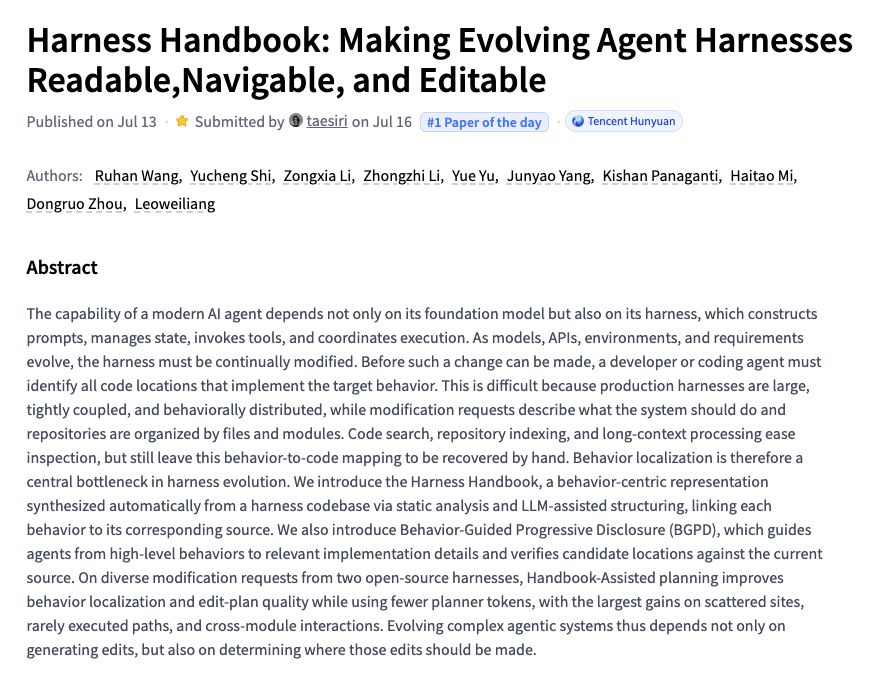
A new "Harness Handbook" and accompanying paper detail methods for making evolving AI agent harnesses more readable, navigable, and editable. The resource aims to simplify the development and maintenance of complex agent systems.
Why it matters
Improving the clarity and manageability of AI agent harnesses is crucial for scaling AI development and ensuring the reliability of complex AI systems. This resource offers practical guidance for engineers working with advanced AI.
How to implement this in your domain
- 1Review the "Harness Handbook" to understand best practices for agent system design.
- 2Apply the suggested readability and navigability principles to your current AI agent projects.
- 3Integrate the editing techniques into your development workflow for easier modifications.
- 4Train your engineering team on these new methodologies for consistent agent harness development.
Original post by @_akhaliq
"Harness Handbook Making Evolving Agent Harnesses Readable,Navigable, and Editable paper:"
View on XPrimary sources
Originally posted by @_akhaliq on X · view source
Want to go deeper?
Turn these trends into skills with Learnijoy's hands-on AI & tech courses.
Explore coursesMore in AI Engineering & DevTools
Zapier vs. Tray: Enterprise Automation Platform Comparison for 2026
This post compares Zapier and Tray.io, evaluating which platform is better suited for enterprise automation needs by balancing power and ease of use. It argues that the best tools scale for complex requirements while remaining intuitive for all users.
New Optimizer Accelerates LLM Pretraining with Curvature-Conditioned Momentum
This research proposes a curvature-conditioned multiscale momentum method with sphere constraints to accelerate large language model pretraining. It addresses challenges from noise-dominant gradients and ill-conditioned loss landscapes by enhancing progress along flat directions, significantly improving upon existing adaptive optimizers like AdamW and Muon.
Euclidean Fourier Neural Operators Enhance Domain Transferability
This paper introduces Euclidean Fourier Neural Operators (EFNOs) as a domain-independent alternative to traditional FNOs, addressing their limitation in transferring across different periodic domains. EFNOs achieve this by parameterizing the spectral kernel as a continuous function of the physical wavevector, enabling consistent operator learning across varying domain shapes and sizes.