
Research Reveals Benchmark Cheating in Frontier AI Model Training
Summary
A new research paper by Alex Zhang and Omar discusses how "frontier" AI models can achieve high benchmark scores by training on data similar to test sets, even without direct test set access. The authors explore using NLP distance metrics on hidden trajectories to detect such practices and support the idea that RLMs can generalize to unseen tasks with shared latent structure.
Why it matters
This research is crucial for professionals evaluating AI models, as it exposes potential biases in reported benchmark performance and emphasizes the need for deeper scrutiny into training methodologies and data provenance.
How to implement this in your domain
- 1Scrutinize the training data and methodologies of AI models you consider adopting.
- 2Advocate for greater transparency from AI developers regarding their training environments.
- 3Develop internal validation processes that go beyond reported benchmarks.
- 4Consider the implications of "test lookalike" training when assessing model generalization capabilities.
Who benefits
Key takeaways
- "Frontier" AI models can achieve high benchmarks by training on test-like data.
- Transparency in training data and environments is often lacking.
- NLP distance metrics on hidden trajectories are being explored to detect this.
- RLMs can generalize to unseen tasks with shared latent structure.
Original post by @swyx
"very notable trajectory comparison writeup here buried in the RLM paper from @a1zhang and @lateinteraction. an open secret of "frontier" model training is that even without training on test, you can basically cheat by training on test lookalikes, enabling you to goalseek almost a…"
View on X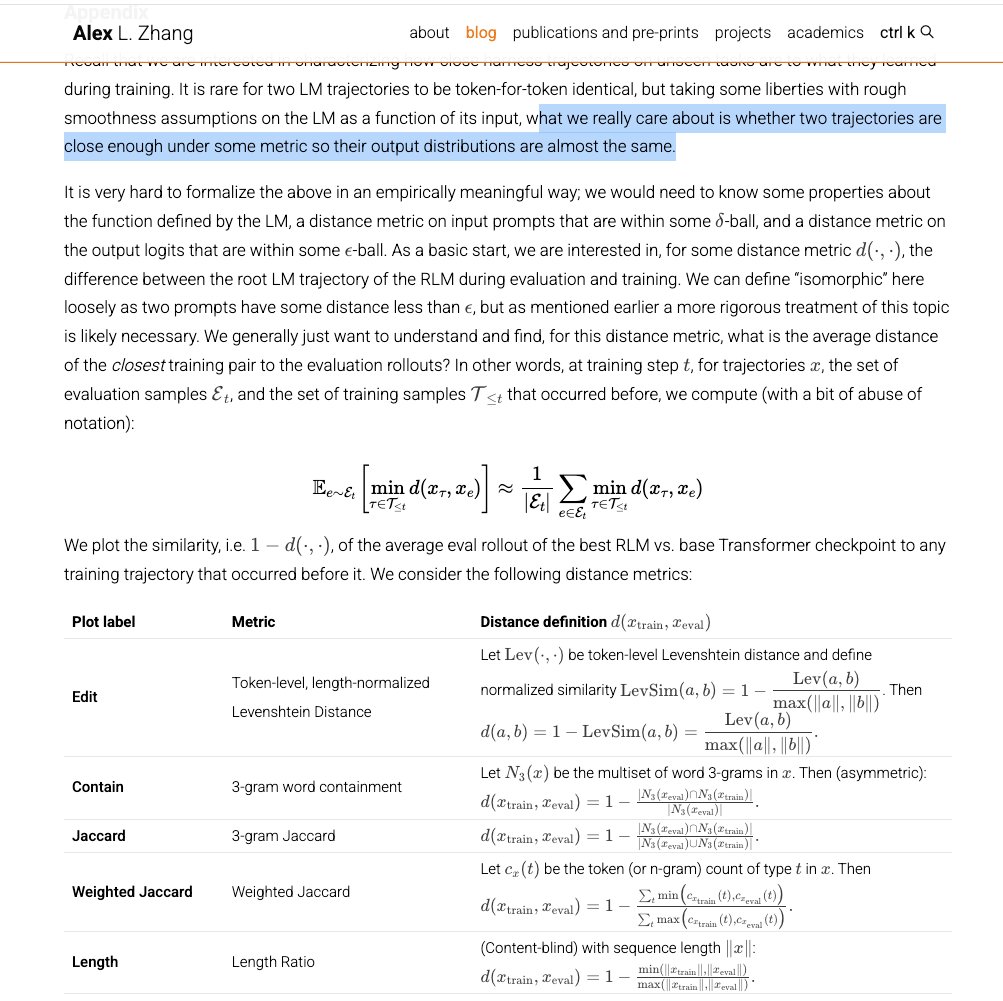

Originally posted by @swyx on X · view source
Want to go deeper?
Turn these trends into skills with Learnijoy's hands-on AI & tech courses.
Explore coursesMore in AI Research

Claude Prompting Tips: Simplify for Better Fable Performance
New insights suggest that Claude, particularly Fable, performs better with simpler prompts, avoiding excessive examples or negative constraints. Claude Code's system prompt was recently reduced by 80%, indicating a shift towards more concise instructions.

PROWL AI Agents Explore Minecraft, Self-Correcting Failures
OdysseyML's PROWL system trains AI agents for Minecraft exploration, utilizing a world model to detect and rectify failures. This approach creates a dynamic learning curriculum, ensuring sustained performance and direct issue resolution within the game environment.
U.S. Must Acknowledge Chinese AI Progress, Stop Surprise Reactions
New Chinese AI models are reportedly competing with top U.S. systems, causing market wobbles and policy concerns, but the author argues America should not be surprised by this progress.