
AI Accelerates Next-Generation Medicine Design and Development
Summary
Developing new medicines is a costly and often unsuccessful endeavor, with many potential drug candidates failing to reach patients. Artificial intelligence is now being leveraged to assist scientists in designing the next generation of therapies, particularly for biologic medicines derived from engineered proteins.
Why it matters
Professionals in biotech, pharma, and healthcare innovation can leverage AI to significantly reduce R&D costs, accelerate drug discovery timelines, and increase the success rate of bringing new therapies to market.
How to implement this in your domain
- 1Explore AI platforms and tools specifically designed for drug discovery and protein engineering.
- 2Invest in training scientific teams on AI/ML methodologies relevant to pharmaceutical R&D.
- 3Form partnerships with AI research institutions or specialized tech companies.
- 4Pilot AI-driven drug design projects to identify promising candidates more efficiently.
Who benefits
Key takeaways
- AI is revolutionizing drug discovery by improving efficiency.
- The development of biologic medicines can be significantly accelerated by AI.
- AI helps overcome the high cost and failure rates in traditional drug R&D.
- Integrating AI can lead to faster delivery of new therapies to patients.
Original post by MIT Technology Review Insights
"Designing and developing a new medicine is an expensive, failure-prone scientific challenge. A new drug can take many years to develop, at the cost of a significant investment. And even then, most possible candidates never reach the patient. For biologic medicines, therapies made…"
View on XOriginally posted by MIT Technology Review Insights on X · view source
Want to go deeper?
Turn these trends into skills with Learnijoy's hands-on AI & tech courses.
Explore coursesMore in AI Research
Agentic Retrieval for Amazon Bedrock Knowledge Bases
This post explains how agentic retrieval addresses multi-part questions where classic retrieval falls short, detailing the AgenticRetrieveStream API's functionality and when to use it over the standard Retrieve API.

Black Forest Labs Unveils Multimodal FLUX 3 AI Model
Black Forest Labs has launched FLUX 3, a new multimodal foundation model that learns jointly from images, videos, and audio within a unified architecture, extending its capabilities into the physical world.
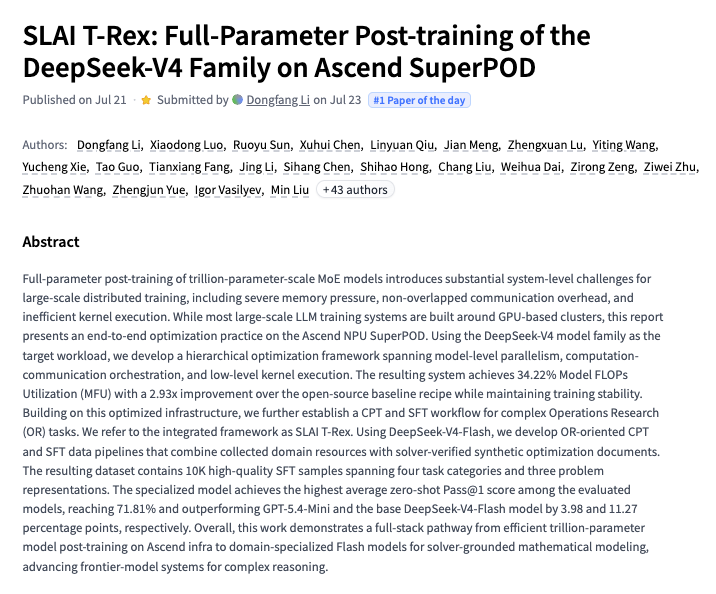
SLAI T-Rex Post-Trains DeepSeek-V4 on Ascend SuperPOD
A new research paper details the full-parameter post-training of the DeepSeek-V4 family of models using the SLAI T-Rex method on an Ascend SuperPOD. This work explores advanced training techniques for large language models.