
Steering Materials Science Concepts in Open-Weight LLMs
Summary
A new research paper explores methods for reading and steering the internal representations of materials science mechanisms within an open-weight language model. This work aims to enhance AI's ability to understand and manipulate complex scientific concepts.
Why it matters
This research is crucial for advancing AI applications in specialized scientific domains, particularly materials science, by enabling more precise control and understanding of how AI models process complex technical information.
How to implement this in your domain
- 1Review the paper to understand techniques for probing and steering LLM representations in scientific contexts.
- 2Explore applying similar representation steering methods to your domain-specific AI models.
- 3Consider how enhanced AI understanding of scientific mechanisms could accelerate R&D in your industry.
Who benefits
Key takeaways
- Research focuses on interpreting and steering materials science concepts in LLMs.
- The goal is to enhance AI's understanding of complex scientific mechanisms.
- This could lead to more sophisticated AI tools for scientific discovery.
- It applies to open-weight language models.
Original post by @_akhaliq
"Reading and Steering Representations of Materials Science Mechanisms in an Open Weight Language Model paper:"
View on XPrimary sources
Originally posted by @_akhaliq on X · view source
Want to go deeper?
Turn these trends into skills with Learnijoy's hands-on AI & tech courses.
Explore coursesMore in AI Research
Agentic Retrieval for Amazon Bedrock Knowledge Bases
This post explains how agentic retrieval addresses multi-part questions where classic retrieval falls short, detailing the AgenticRetrieveStream API's functionality and when to use it over the standard Retrieve API.

Black Forest Labs Unveils Multimodal FLUX 3 AI Model
Black Forest Labs has launched FLUX 3, a new multimodal foundation model that learns jointly from images, videos, and audio within a unified architecture, extending its capabilities into the physical world.
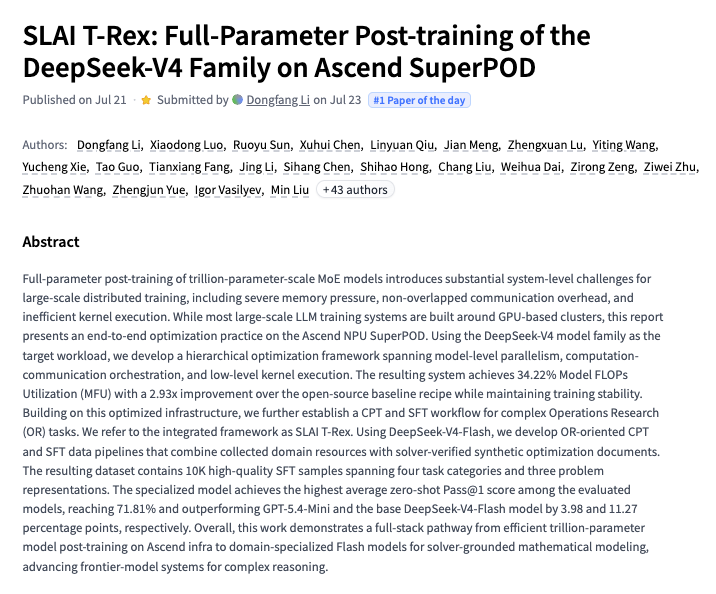
SLAI T-Rex Post-Trains DeepSeek-V4 on Ascend SuperPOD
A new research paper details the full-parameter post-training of the DeepSeek-V4 family of models using the SLAI T-Rex method on an Ascend SuperPOD. This work explores advanced training techniques for large language models.