
Vernor Vinge's 2007 Sci-Fi Predicted Mass Digitization
Summary
Marc Andreessen praised Vernor Vinge in 2007 as a top forecaster, highlighting his novel "Rainbows End" for its plausible predictions. The book described a "Librareome Project" involving the rapid, destructive digitization of physical books, a concept now seen as prescient.
Why it matters
This highlights the long-term predictive power of thoughtful science fiction and the accelerating pace of digital transformation, reminding professionals to consider radical future scenarios.
How to implement this in your domain
- 1Read influential science fiction to spark innovative thinking about future tech.
- 2Conduct "future-proofing" workshops to explore extreme technological scenarios.
- 3Encourage cross-functional teams to brainstorm disruptive technologies.
- 4Investigate emerging digitization techniques for archival or data management.
Who benefits
Key takeaways
- Science fiction can offer surprisingly accurate long-term technological predictions.
- Vernor Vinge's "Rainbows End" foresaw radical mass-digitization methods.
- The pace of digital transformation continues to challenge traditional paradigms.
- Considering extreme future scenarios is valuable for strategic planning.
Original post by @packyM
"In 2007, @pmarca called Vernor Vinge "one of the best forecasters in the world" along with Arthur C. Clarke. Rainbows End had just come out, and Marc said it was "the clearest and most plausible extrapolation of modern technology trends forward to the year 2025 that you can imagi…"
View on X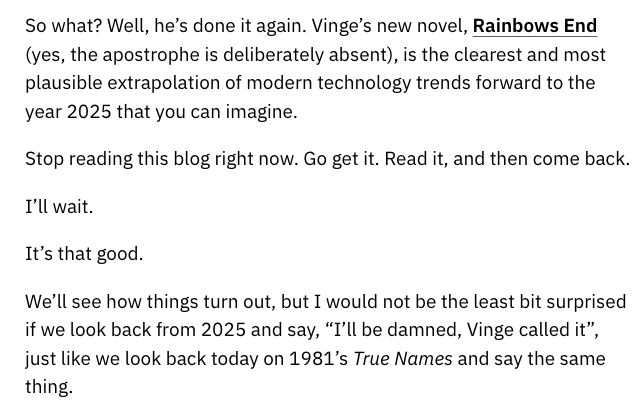
Primary sources
Originally posted by @packyM on X · view source
Want to go deeper?
Turn these trends into skills with Learnijoy's hands-on AI & tech courses.
Explore coursesMore in AI News & Tools
AI Model Improves Trustworthy Flood Prediction with Explainability
Researchers developed Context-Aware Concept Distillation (CACD), a framework that distills opaque Deep Learning models into interpretable, hydrology-aware surrogates for flood prediction. This method provides verifiable causal narratives required by disaster response authorities, achieving high fidelity and outperforming black-box baselines globally.
Foundation Models Revolutionize Time Series Forecasting with Fine-Tuning
This work reviews the emerging paradigm of foundation models for zero-shot time series forecasting, highlighting their ability to provide accurate predictions on unseen datasets. It demonstrates that fine-tuning these models consistently improves forecasting accuracy over zero-shot baselines, offering a unified and efficient solution for diverse forecasting problems.
HarmAlign Enhances Open-Weight Model Safety Against Fine-Tuning
HarmAlign is a new method that prevents harmful fine-tuning of open-weight models while preserving benign adaptability, using function-preserving spectral deformation along an estimated contrastive activation subspace. It provides finite-sample guarantees for curvature control, blocking various attacks and accidental safety degradation.