
CRISPR's Market Expands with New Programmable Chemotherapy Discovery
Summary
A new molecular kill switch, described as a programmable chemotherapy, has been discovered that recognizes specific RNA. This advancement significantly broadens the total addressable market for CRISPR technology companies.
Why it matters
This development could revolutionize targeted therapies, offering new treatment modalities for diseases and significantly increasing investment and innovation opportunities in the biotech and pharmaceutical sectors.
How to implement this in your domain
- 1Investigate potential partnerships with biotech firms exploring RNA-targeting therapies.
- 2Monitor clinical trials and research developments in programmable chemotherapy.
- 3Assess the ethical and regulatory landscape for new gene-editing and RNA-targeting technologies.
- 4Diversify R&D portfolios to include potential applications of this new "kill switch" mechanism.
Who benefits
Key takeaways
- A new molecular "kill switch" targets specific RNA, acting as programmable chemotherapy.
- This discovery significantly expands the market potential for CRISPR companies.
- It represents a major advancement in targeted therapeutic approaches.
- The technology could lead to highly precise disease treatments.
Original post by @nathanbenaich
"the TAM for crispr companies just got even bigger 👀 “It’s a molecular kill switch that recognizes a particular RNA,” says Yang Liu, a molecular biologist at the University of Utah School of Medicine in Salt Lake City, and an author of one of the papers. “This is basically a prog…"
View on X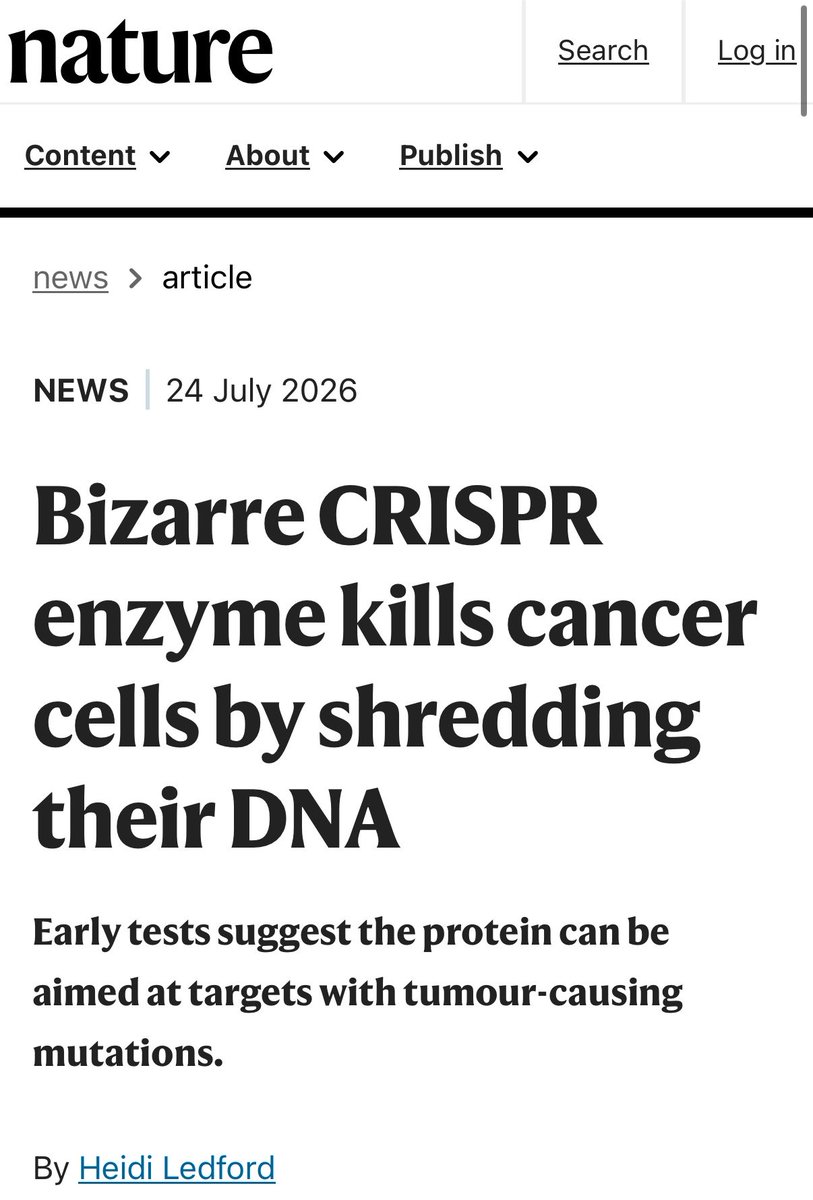
Originally posted by @nathanbenaich on X · view source
Want to go deeper?
Turn these trends into skills with Learnijoy's hands-on AI & tech courses.
Explore coursesMore in AI Research
StageGuard Improves Sleep Staging by Enforcing Physiological Constraints
StageGuard is a new framework that enhances automated sleep staging by integrating physiology-informed priors, ensuring that deep learning models produce hypnograms that adhere to known biological rules. It significantly reduces physiologically implausible transitions and fragmentation while maintaining or improving accuracy.
AI Model Improves Trustworthy Flood Prediction with Explainability
Researchers developed Context-Aware Concept Distillation (CACD), a framework that distills opaque Deep Learning models into interpretable, hydrology-aware surrogates for flood prediction. This method provides verifiable causal narratives required by disaster response authorities, achieving high fidelity and outperforming black-box baselines globally.
Diffusion Models' Generative Quality Gets Comprehensive Theoretical Analysis
This research provides a unified theoretical framework for understanding the generalization and convergence of score-based diffusion models. It decomposes the total generative error into four interpretable components, quantifying how training data, discretization, and optimization affect sample fidelity.