
Anthropic Clarifies Stance on Open-Weights AI Models
Summary
Anthropic CEO Dario Amodei has publicly stated that the company has never advocated for a ban on open-weights AI models, asserting that such a ban would protect US AI companies from competition, which is not his objective. This statement addresses prior criticism regarding Anthropic's perceived reluctance to endorse open systems.
Why it matters
This clarification from a major AI player impacts the ongoing debate about open-source AI, regulatory approaches, and competitive dynamics in the industry. It signals Anthropic's alignment with a more open ecosystem, which could influence future collaborations and policy discussions.
How to implement this in your domain
- 1Stay informed about the evolving landscape of open-source AI policies and positions.
- 2Evaluate the implications of open-weights models for your AI development strategy.
- 3Participate in industry discussions on AI governance and competition.
- 4Consider the benefits and risks of contributing to or utilizing open-source AI projects.
Who benefits
Key takeaways
- Anthropic does not advocate for banning open-weights AI models.
- A ban could reduce competition among US AI companies.
- The debate around open-source AI remains active.
- Anthropic aims to clarify its stance on industry openness.
Original post by @TheRundownAI
"BREAKING: Dario Amodei published Anthropic's official position on open-weights models. He wrote that the company "has never advocated for a ban" and that one "would protect US AI companies from competition, but that has never been my goal." Anthropic has been criticized for being…"
View on X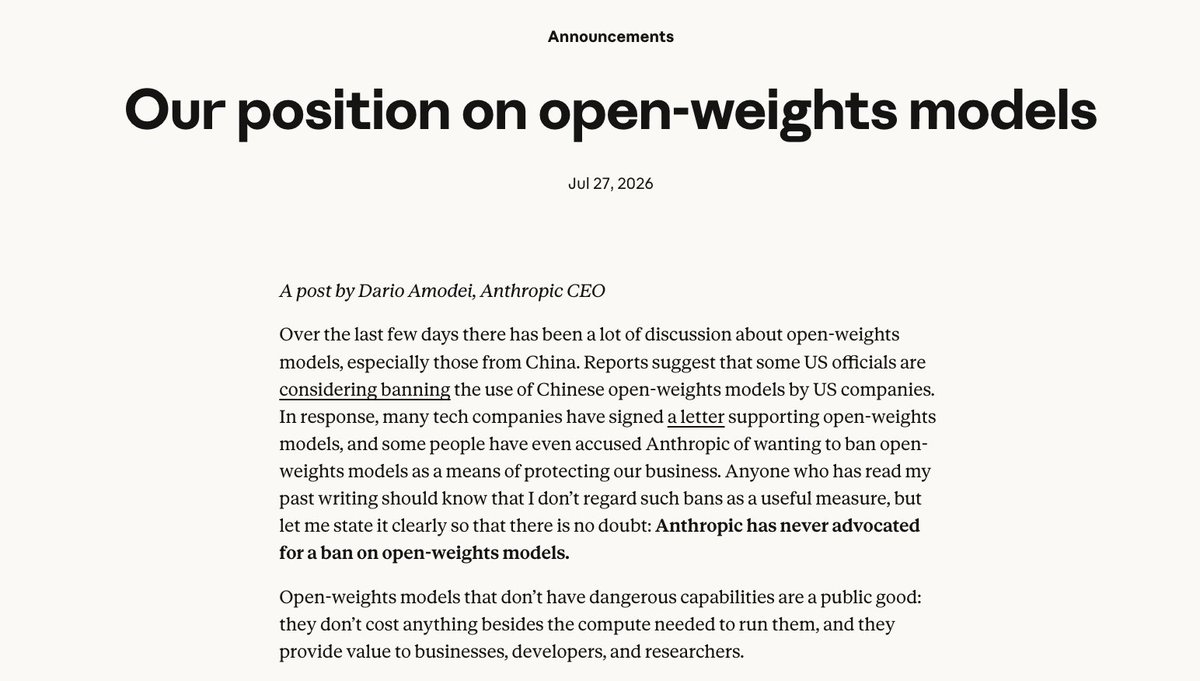
Primary sources
Originally posted by @TheRundownAI on X · view source
Want to go deeper?
Turn these trends into skills with Learnijoy's hands-on AI & tech courses.
Explore coursesMore in AI News & Tools
AI Model Improves Trustworthy Flood Prediction with Explainability
Researchers developed Context-Aware Concept Distillation (CACD), a framework that distills opaque Deep Learning models into interpretable, hydrology-aware surrogates for flood prediction. This method provides verifiable causal narratives required by disaster response authorities, achieving high fidelity and outperforming black-box baselines globally.
Foundation Models Revolutionize Time Series Forecasting with Fine-Tuning
This work reviews the emerging paradigm of foundation models for zero-shot time series forecasting, highlighting their ability to provide accurate predictions on unseen datasets. It demonstrates that fine-tuning these models consistently improves forecasting accuracy over zero-shot baselines, offering a unified and efficient solution for diverse forecasting problems.
HarmAlign Enhances Open-Weight Model Safety Against Fine-Tuning
HarmAlign is a new method that prevents harmful fine-tuning of open-weight models while preserving benign adaptability, using function-preserving spectral deformation along an estimated contrastive activation subspace. It provides finite-sample guarantees for curvature control, blocking various attacks and accidental safety degradation.