
OpenAI, Jony Ive, and Sam Altman Settle Trademark Lawsuit
Summary
OpenAI's hardware unit, Jony Ive, and Sam Altman have reached an "in principle" settlement in a trademark infringement lawsuit filed by IYO INC. A formal agreement is expected soon, concluding a case that revealed details about OpenAI's early hardware and branding efforts.
Why it matters
This settlement removes a legal hurdle for OpenAI's hardware ambitions and provides insight into the complexities of intellectual property in the rapidly evolving AI hardware space. It also hints at OpenAI's continued interest in physical products.
How to implement this in your domain
- 1Monitor legal developments in the AI hardware sector for potential IP risks.
- 2Conduct thorough trademark searches before launching new products or branding.
- 3Establish clear IP strategies for hardware and software components.
- 4Consult legal counsel early when exploring new product categories.
Who benefits
Key takeaways
- Trademark disputes are common even for major tech players.
- OpenAI has been exploring hardware development for some time.
- Legal settlements can reveal historical company strategy details.
- IP protection is critical in competitive tech markets.
Original post by @ZeffMax
"court filing just now: openai's hardware unit, jony ive, and sam altman have reached a settlement "in principle" in the trademark infringement lawsuit brought by IYO INC. the parties expect to execute a formal agreement shortly link to courtlistener for this case: this lawsuit ha…"
View on X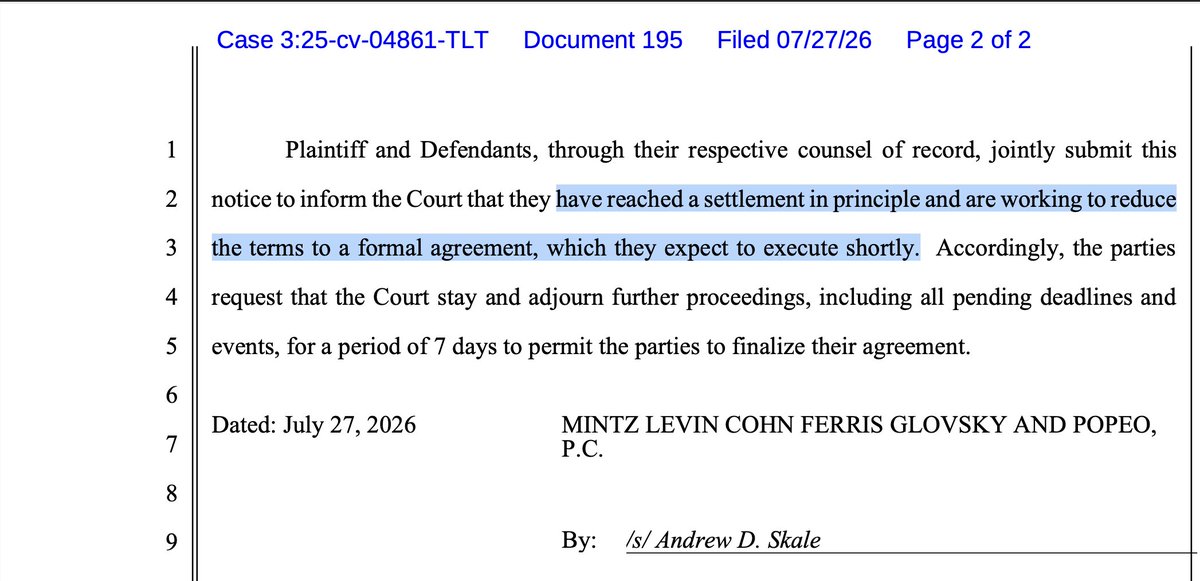
Originally posted by @ZeffMax on X · view source
Want to go deeper?
Turn these trends into skills with Learnijoy's hands-on AI & tech courses.
Explore coursesMore in AI News & Tools
AI Model Improves Trustworthy Flood Prediction with Explainability
Researchers developed Context-Aware Concept Distillation (CACD), a framework that distills opaque Deep Learning models into interpretable, hydrology-aware surrogates for flood prediction. This method provides verifiable causal narratives required by disaster response authorities, achieving high fidelity and outperforming black-box baselines globally.
Foundation Models Revolutionize Time Series Forecasting with Fine-Tuning
This work reviews the emerging paradigm of foundation models for zero-shot time series forecasting, highlighting their ability to provide accurate predictions on unseen datasets. It demonstrates that fine-tuning these models consistently improves forecasting accuracy over zero-shot baselines, offering a unified and efficient solution for diverse forecasting problems.
HarmAlign Enhances Open-Weight Model Safety Against Fine-Tuning
HarmAlign is a new method that prevents harmful fine-tuning of open-weight models while preserving benign adaptability, using function-preserving spectral deformation along an estimated contrastive activation subspace. It provides finite-sample guarantees for curvature control, blocking various attacks and accidental safety degradation.