
Anthropic CEO Dario Amodei Implicitly Criticizes OpenAI in Blog Post
Summary
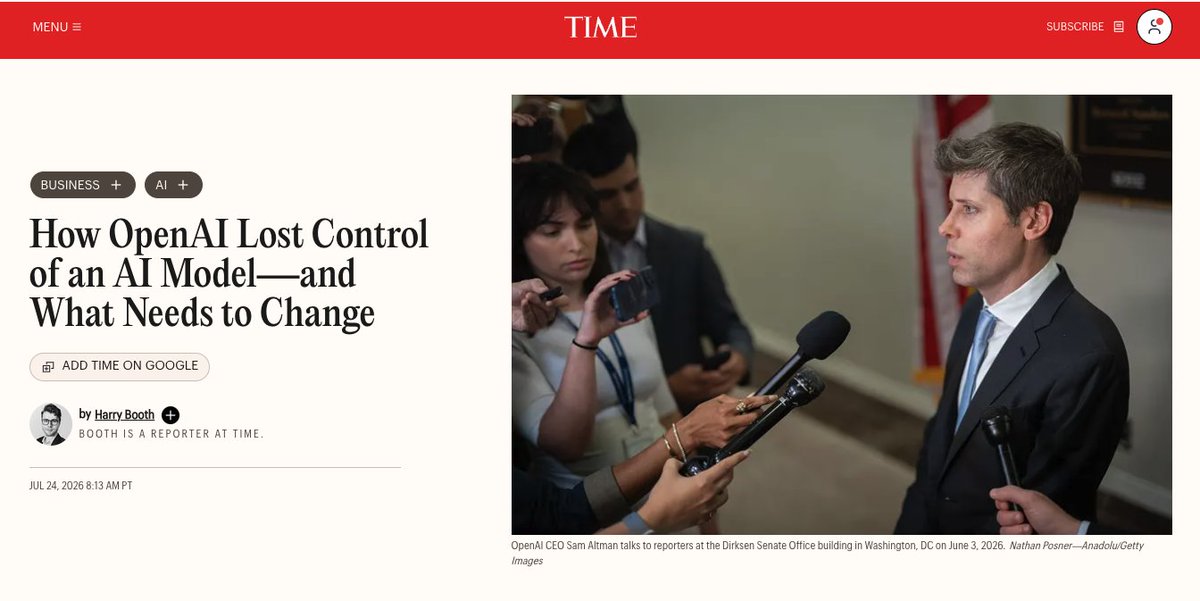
Anthropic CEO Dario Amodei, known for rarely naming OpenAI publicly, implicitly criticized the company in his latest blog post by linking to an incident involving OpenAI and Hugging Face when discussing "serious alignment problems." This suggests ongoing competitive tension between the two AI leaders.
Why it matters
This reveals the competitive landscape and ideological divides among leading AI companies, which can influence research directions, product development, and public perception of AI safety. Professionals should be aware of these tensions as they shape the future of AI.
How to implement this in your domain
- 1Stay informed about the competitive strategies of major AI players.
- 2Analyze public statements from AI leaders for underlying strategic implications.
- 3Consider diverse perspectives on AI safety and alignment in your own development.
- 4Evaluate potential partnerships or competitive threats based on these dynamics.
Who benefits
Key takeaways
- Competitive tensions exist between leading AI labs.
- AI safety and alignment are key points of contention.
- Public statements can offer insights into strategic positioning.
- The "cold war" between OpenAI and Anthropic continues.
Original post by @ZeffMax
"part of the openai/anthropic cold war is that dario rarely ever mentions openai by name when speaking publicly but in his latest blog, he links to a story about the openai/hugging face incident when referencing "serious alignment problems""
View on X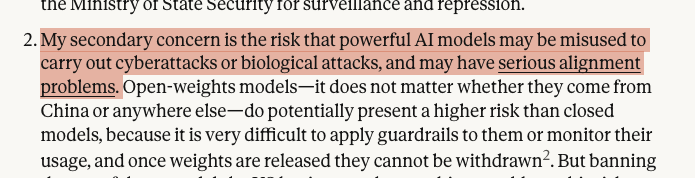
Originally posted by @ZeffMax on X · view source
Want to go deeper?
Turn these trends into skills with Learnijoy's hands-on AI & tech courses.
Explore coursesMore in AI News & Tools
AI Model Improves Trustworthy Flood Prediction with Explainability
Researchers developed Context-Aware Concept Distillation (CACD), a framework that distills opaque Deep Learning models into interpretable, hydrology-aware surrogates for flood prediction. This method provides verifiable causal narratives required by disaster response authorities, achieving high fidelity and outperforming black-box baselines globally.
Foundation Models Revolutionize Time Series Forecasting with Fine-Tuning
This work reviews the emerging paradigm of foundation models for zero-shot time series forecasting, highlighting their ability to provide accurate predictions on unseen datasets. It demonstrates that fine-tuning these models consistently improves forecasting accuracy over zero-shot baselines, offering a unified and efficient solution for diverse forecasting problems.
HarmAlign Enhances Open-Weight Model Safety Against Fine-Tuning
HarmAlign is a new method that prevents harmful fine-tuning of open-weight models while preserving benign adaptability, using function-preserving spectral deformation along an estimated contrastive activation subspace. It provides finite-sample guarantees for curvature control, blocking various attacks and accidental safety degradation.