
StateAct Paper Introduces New Computer-Use Agents
Summary
A new research paper titled "StateAct: Program State, before Pixels, for Long-Horizon Computer-Use Agents" has been released. The paper introduces a novel approach for AI agents to interact with computers by focusing on program state rather than visual pixels.
Why it matters
This research could significantly advance the capabilities of autonomous AI agents, making them more reliable and effective for complex, long-duration tasks in various professional settings. It offers a potential pathway to more robust automation.
How to implement this in your domain
- 1Review the StateAct paper to understand the technical details and implications for agent design.
- 2Explore how a "program state"-centric approach could enhance existing automation scripts or AI workflows.
- 3Consider integrating similar principles into the development of new AI agents for internal tools or customer-facing applications.
- 4Evaluate the potential for more reliable long-horizon task automation in your organization.
Who benefits
Key takeaways
- StateAct proposes AI agents interact with computers via program state, not pixels.
- This approach aims to improve long-horizon computer-use agents.
- It could lead to more robust and efficient automation.
- The research represents a significant step in AI agent design.
Original post by @_akhaliq
"StateAct Program State, before Pixels, for Long-Horizon Computer-Use Agents paper:"
View on X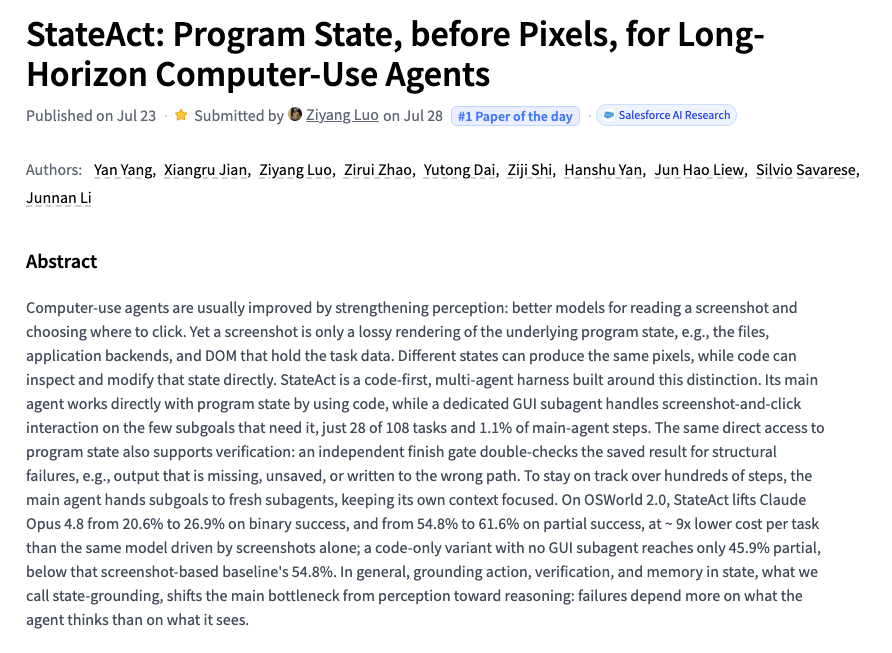
Primary sources
Originally posted by @_akhaliq on X · view source
Want to go deeper?
Turn these trends into skills with Learnijoy's hands-on AI & tech courses.
Explore coursesMore in AI Research
StageGuard Improves Sleep Staging by Enforcing Physiological Constraints
StageGuard is a new framework that enhances automated sleep staging by integrating physiology-informed priors, ensuring that deep learning models produce hypnograms that adhere to known biological rules. It significantly reduces physiologically implausible transitions and fragmentation while maintaining or improving accuracy.
AI Model Improves Trustworthy Flood Prediction with Explainability
Researchers developed Context-Aware Concept Distillation (CACD), a framework that distills opaque Deep Learning models into interpretable, hydrology-aware surrogates for flood prediction. This method provides verifiable causal narratives required by disaster response authorities, achieving high fidelity and outperforming black-box baselines globally.
Diffusion Models' Generative Quality Gets Comprehensive Theoretical Analysis
This research provides a unified theoretical framework for understanding the generalization and convergence of score-based diffusion models. It decomposes the total generative error into four interpretable components, quantifying how training data, discretization, and optimization affect sample fidelity.