
GPT-5.6 Sol Performance Triples with API Settings Adjustment
Summary
GPT-5.6 Sol, despite solving math problems, struggled with the ARC-AGI-3 2D puzzle benchmark until researchers enabled "retained reasoning" and "context compaction" API settings, tripling its score with fewer tokens.
Why it matters
This research demonstrates that effective deployment and evaluation of advanced AI models heavily depend on API configurations and harness design, not just the model's inherent capabilities. Professionals need to understand these nuances to maximize model performance and interpret benchmarks accurately.
How to implement this in your domain
- 1Review current LLM integration strategies to ensure optimal API settings are being utilized.
- 2Experiment with "retained reasoning" and "context compaction" for agentic or long-running AI applications.
- 3Evaluate existing AI benchmarks and internal testing harnesses for potential biases introduced by API settings.
- 4Prioritize using the latest API versions (e.g., Responses API over legacy Chat Completions API) for better features.
- 5Train development teams on best practices for prompt engineering and API configuration to enhance model performance.
Who benefits
Key takeaways
- API settings and harness design significantly impact LLM performance in benchmarks.
- "Retained reasoning" and "context compaction" can dramatically improve agentic model capabilities.
- Benchmark scores reflect both the model and the evaluation environment.
- Optimizing API usage can lead to better results and reduced token costs.
Original post by @OpenAI
"GPT-5.6 Sol has been used to solve open problems in mathematics. So why was it struggling with ARC-AGI-3, a benchmark of 2D puzzle games? We investigated. The harness was not letting it remember what it had learned. We found that enabling two API settings tripled our scores with…"
View on X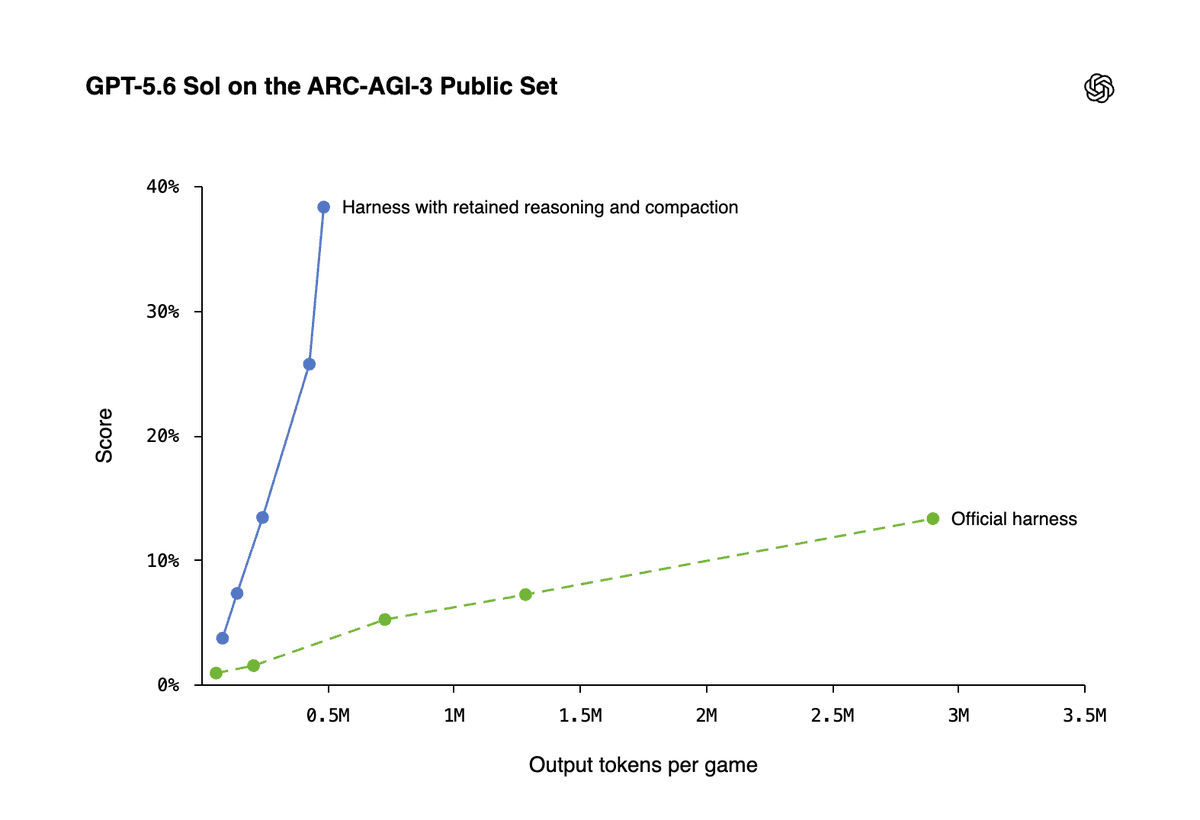
Primary sources
Originally posted by @OpenAI on X · view source
Want to go deeper?
Turn these trends into skills with Learnijoy's hands-on AI & tech courses.
Explore coursesMore in AI Engineering & DevTools
Zapier vs. Tray: Enterprise Automation Platform Comparison for 2026
This post compares Zapier and Tray.io, evaluating which platform is better suited for enterprise automation needs by balancing power and ease of use. It argues that the best tools scale for complex requirements while remaining intuitive for all users.
Amortized Moment Matching Boosts Visual Generation Quality
Researchers propose amortized moment matching (AMFD), a new technique that uses neural networks to learn data moments as distributional training signals, significantly improving visual generation quality and instruction-following in text-to-image models.
TREA-Net Improves Dengue Forecasting in Data-Scarce Regions
TREA-Net is a new framework that enhances neural forecasting models for multi-week dengue incidence prediction, especially in regions with limited historical data, by transferring knowledge from data-rich areas and adapting to local epidemiological dynamics.