
Anthropic Extends Claude 3.5 Sonnet Access for Paid Plans
Summary
Anthropic has announced an extension of access to its Claude 3.5 Sonnet model for all users on paid plans, now available through July 12.
Why it matters
Professionals can leverage this extended access to evaluate Claude 3.5 Sonnet's capabilities for their specific use cases, integrating it into workflows or developing new applications before general availability changes.
How to implement this in your domain
- 1Access the Claude 3.5 Sonnet model through your existing paid Anthropic account.
- 2Experiment with its advanced reasoning, coding, and multimodal capabilities for specific tasks.
- 3Integrate the model into prototypes or internal tools to assess performance and efficiency.
- 4Provide feedback to Anthropic on model performance and potential improvements.
- 5Plan for potential future integration based on the trial period's results.
Who benefits
Key takeaways
- Anthropic is extending access to Claude 3.5 Sonnet for paid plan users.
- The extended access period runs until July 12.
- This offers a valuable opportunity to test the model's new features.
Original post by @minchoi
"Anthropic: "We're extending access to Claude Fable 5 on all paid plans through July 12." Me: 💀 @andrew_Tas 💀 @TheAIShrink 🤔"
View on X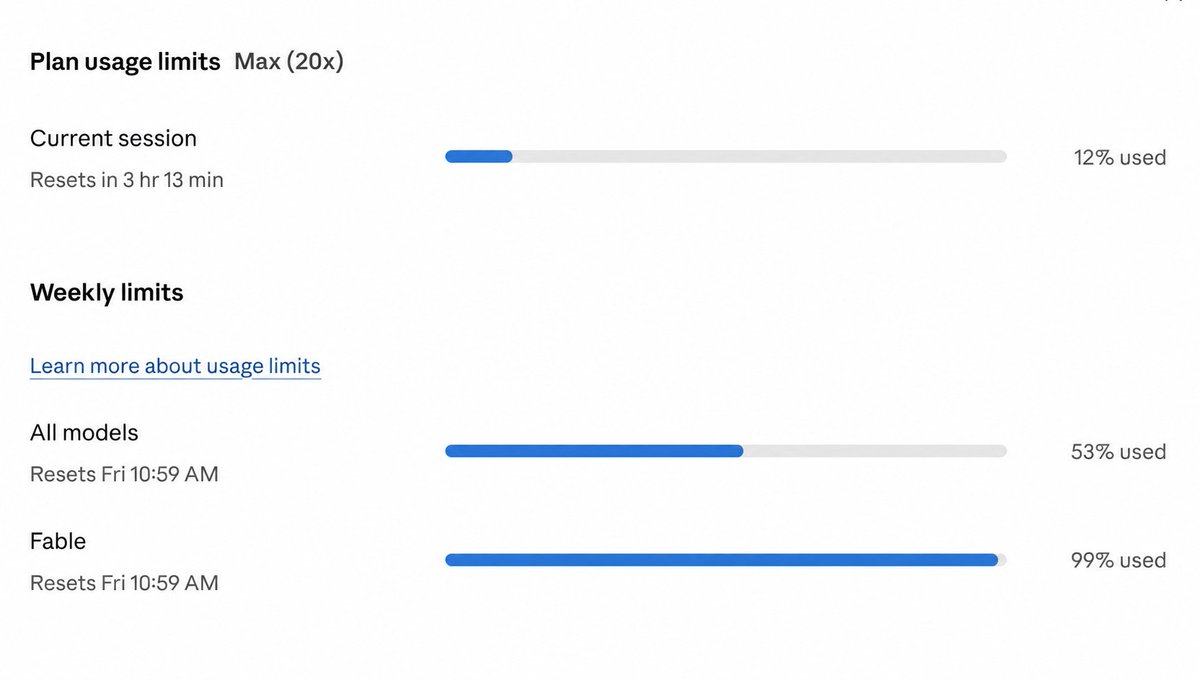
Originally posted by @minchoi on X · view source
Want to go deeper?
Turn these trends into skills with Learnijoy's hands-on AI & tech courses.
Explore coursesMore in AI News & Tools

GPT-5.6 Sol, Terra, Luna Models Launch Thursday
OpenAI is confirmed to release new GPT-5.6 models, Sol, Terra, and Luna, on Thursday, July 9th. This expands the available advanced language models for developers and businesses.
AI Tools Show Promise in Arab University English Classrooms
A systematic review of studies from 2023-2025 reveals that Arab university English language learners generally have positive attitudes towards AI tools for drafting, revision, and practice. While surface-level writing improvements are consistent, gains in higher-order writing and speaking often depend on teacher mediation.
Peer Review Scores Fail to Predict AI Research Impact
A study analyzing ICLR papers from 2017-2025 found that traditional peer review scores are not correlated with a paper's future disruptiveness or its ability to redirect future research. The research introduces new metrics to identify "catalyst" papers that significantly influence AI development.