
Explore Grok 4.5 for AI Agent Integration
Summary
The post recommends integrating Grok 4.5 into AI agents, implying it offers significant benefits for such applications. It encourages users to try it out for improved performance.
Why it matters
Staying updated on new AI model releases and their recommended applications is crucial for engineers and product managers looking to optimize AI agent performance and capabilities.
How to implement this in your domain
- 1Research: Investigate Grok 4.5's specific features, benchmarks, and pricing.
- 2Experiment: Set up a small-scale pilot project to test Grok 4.5 within an existing AI agent.
- 3Compare: Benchmark its performance against current models used in your agents.
- 4Integrate: Develop a plan for full integration if the pilot proves successful.
Who benefits
Key takeaways
- Grok 4.5 is recommended for AI agent development.
- New model iterations can significantly improve agent performance.
- Continuous evaluation of AI models is essential for competitive advantage.
- Experimentation is key to validating new tool recommendations.
Original post by @minchoi
"Try Grok 4.5 in your AI agent... Thank me later @rahulnanda86 Which sub? @dedene 🙌"
View on X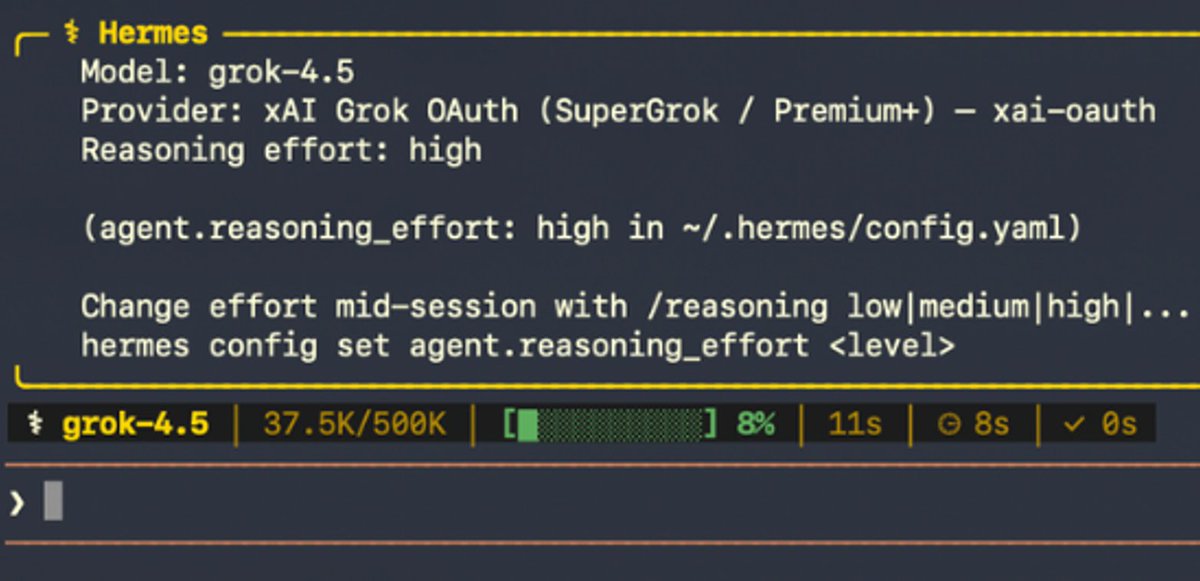
Originally posted by @minchoi on X · view source
Want to go deeper?
Turn these trends into skills with Learnijoy's hands-on AI & tech courses.
Explore coursesMore in AI Engineering & DevTools
Optimizing uvx in GitHub Actions for Cache Efficiency
The post details a method for running uvx tool-name within GitHub Actions that prevents repeated package downloads, improving build performance. It provides a cache-friendly recipe for this common development workflow.
Muse Spark 1.1 Rivals GPT-5.6 Sol on HealthBench Pro, Cuts Costs
Muse Spark 1.1 demonstrates comparable, possibly superior, performance to GPT-5.6 Sol on the HealthBench Pro benchmark. This achievement is notable as it comes at a significantly lower operational cost.

SQLite Recursive CTE Powers Novel Ray Tracer Implementation
A new project demonstrates a ray tracer built entirely using SQLite's recursive Common Table Expressions, storing its state on disk. This unique approach allows other tools to query the ray tracer's state in real-time, exemplified by a custom HTML+JS minimap.