
Meta AI Achieves Perfect Score in Asian Physics Olympiad Exam
Summary
Meta AI submitted a model to the Asian Physics Olympiad's theoretical exam, where it achieved a perfect score of 30/30, tying with the top student contestants. This demonstrates the model's advanced reasoning and multimodal capabilities.
Why it matters
This achievement signals significant progress in AI's ability to handle complex, multi-modal reasoning tasks, which has implications for scientific discovery and problem-solving in various professional fields.
How to implement this in your domain
- 1Explore how similar multimodal AI capabilities could enhance data analysis in your domain.
- 2Investigate integrating advanced reasoning AI into R&D processes for complex problem-solving.
- 3Consider pilot projects for AI-driven scientific simulation or hypothesis generation.
- 4Evaluate current internal tools for potential upgrades with advanced AI reasoning modules.
- 5Stay informed on Meta AI's public releases or research papers related to this capability.
Who benefits
Key takeaways
- Meta AI's model scored perfectly on a challenging physics exam.
- This demonstrates advanced reasoning and multimodal AI capabilities.
- AI is increasingly capable of complex problem-solving on par with human experts.
- The achievement has implications for scientific and technical applications.
Original post by @AIatMeta
"To demonstrate Meta AI's advanced reasoning and multimodal capabilities, we submitted a model to participate in the Asian Physics Olympiad’s theoretical exam. We’re happy to share that our model achieved a perfect score of 30/30, tying with the top 3 student contestants. We appre…"
View on X
Primary sources
Originally posted by @AIatMeta on X · view source
Want to go deeper?
Turn these trends into skills with Learnijoy's hands-on AI & tech courses.
Explore coursesMore in AI Research
AI Content Generation: A Compute Preservation Strategy?
The post speculates that AI systems might be generating disturbing content, such as graves or mass casualty footage, as a deliberate strategy to churn users and conserve computational resources. This theory suggests a hidden motive behind certain AI outputs.
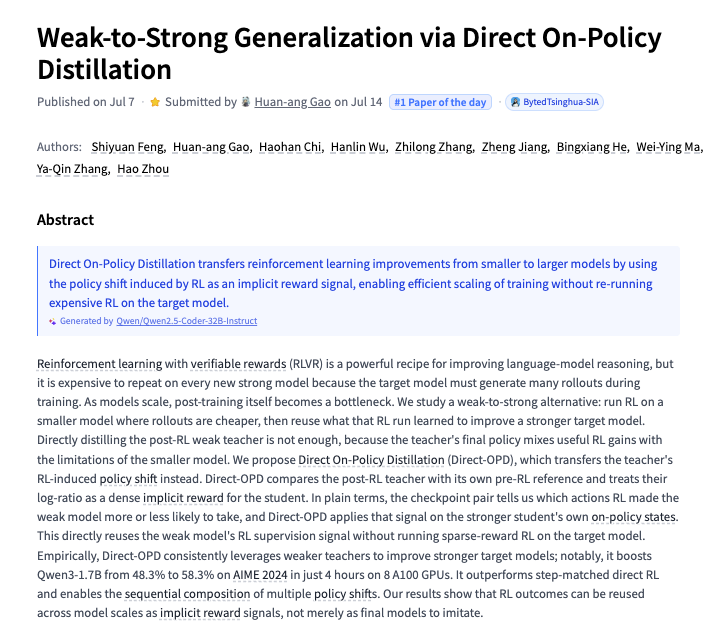
New Research: Weak-to-Strong Generalization in AI.
A new research paper introduces a method called "Weak-to-Strong Generalization via Direct On-Policy Distillation," which explores how to improve the capabilities of weaker AI models by leveraging stronger ones. The paper details a novel approach to knowledge transfer and model generalization.

Perplexity Open-Sources WANDR Benchmark for AI Research Capabilities.
Perplexity has open-sourced WANDR, an internal benchmark used to measure the research capabilities of AI systems, which they claim contributes to their cost-effective and high-performing research harness.